Medical Disclaimer: This article is for educational and informational purposes only. It does not constitute medical advice, diagnosis, or treatment. All medical decisions should be made in consultation with a licensed clinician. Individual results vary, and no specific outcomes can be promised. If you have questions about whether any treatment is appropriate for you, speak with a qualified healthcare professional.
Tesamorelin for Adults: What the Research Says About Visceral Fat and Growth Hormone Support
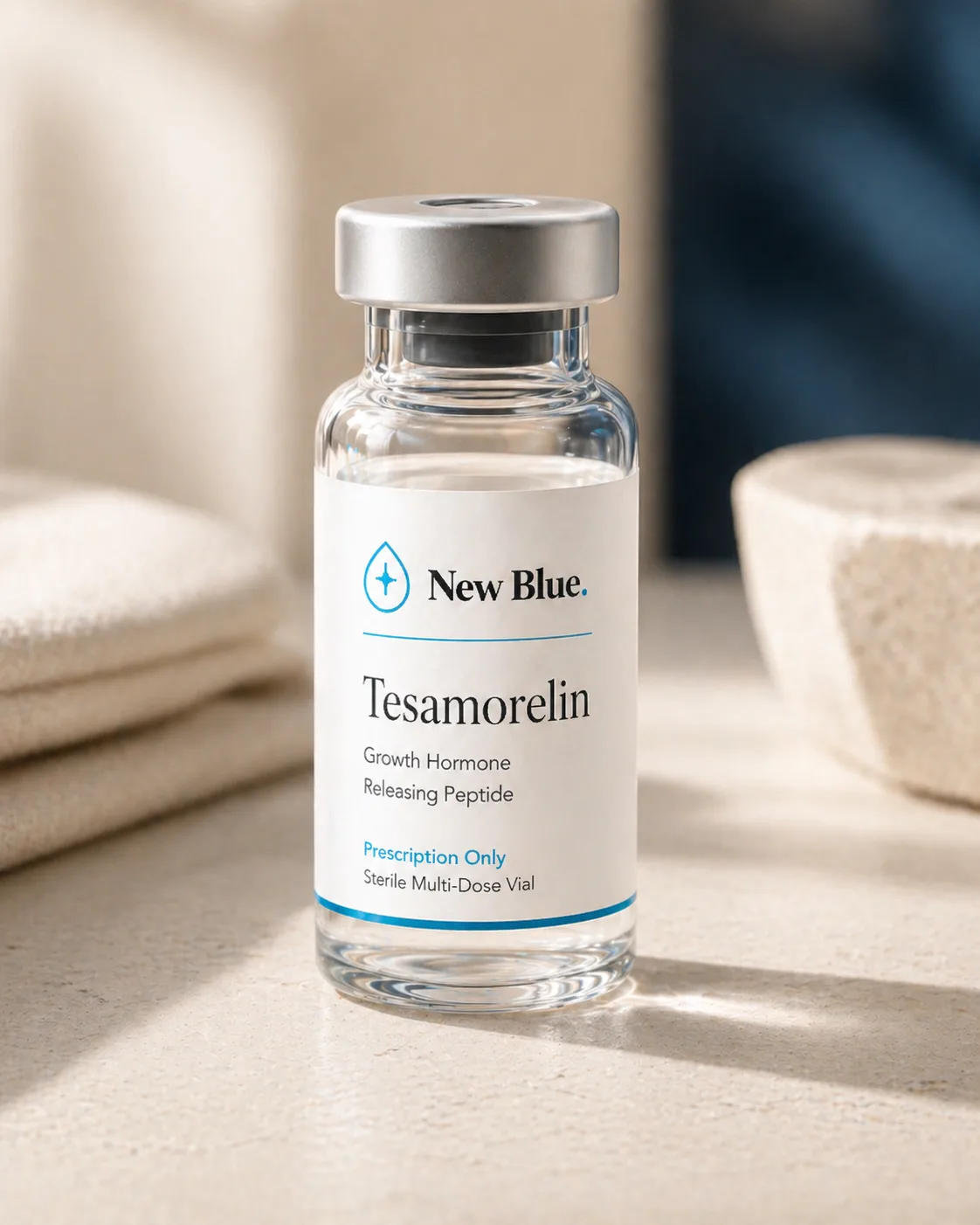
If you're a man between 30 and 55 trying to understand whether tesamorelin can actually help reduce visceral fat, you've probably encountered a frustrating mix of hype, vague claims, and "research chemical" websites that raise more questions than they answer. The science on tesamorelin is more specific—and more nuanced—than most online sources let on. This article breaks down what the published clinical data actually says, who might be a candidate, and how clinician-guided telehealth platforms coordinate access to compounded formulations.
What Is Tesamorelin? A Quick Overview
Tesamorelin is a synthetic analog of growth-hormone-releasing hormone (GHRH), a 44-amino-acid peptide that signals the pituitary gland to produce and secrete growth hormone. Unlike exogenous growth hormone injections, tesamorelin works upstream—it stimulates your body's own GH production rather than replacing it directly.
The branded version, Egrifta, was originally studied for and indicated in the treatment of HIV-associated lipodystrophy, a condition characterized by abnormal fat accumulation, particularly visceral adipose tissue (VAT). That clinical context matters. Most of the robust trial data on tesamorelin comes from HIV-positive populations, and extrapolating those results to the general adult population requires careful interpretation.
Compounded tesamorelin formulations are prepared at state-licensed 503A compounding pharmacies. These are not commercially manufactured products. A licensed clinician must evaluate whether a compounded formulation is appropriate for any individual patient based on their health profile, history, and clinical presentation. For a deeper look at the evidence base, New Blue Health maintains a dedicated tesamorelin evidence page with citations and study summaries.
Understanding Visceral Fat: Why It Matters for Men 30–55
Visceral adipose tissue (VAT) is the metabolically active fat stored deep in the abdominal cavity, surrounding organs like the liver, pancreas, and intestines. It is not the same as subcutaneous fat—the pinchable layer under your skin. The distinction is clinically significant.
Visceral fat produces inflammatory cytokines (IL-6, TNF-α) and is associated with insulin resistance, cardiovascular disease, and metabolic syndrome. Després (2012) published extensively on the concept of "hypertriglyceridemic waist," demonstrating that waist circumference combined with elevated triglycerides is a stronger predictor of cardiovascular risk than BMI alone in men. For men in their 30s through 50s, visceral fat tends to accumulate due to declining testosterone, reduced physical activity, poor sleep, and dietary patterns—sometimes even when overall body weight remains relatively stable.
This is why the scale can be misleading. A man at 195 pounds with high VAT carries a different metabolic risk profile than a man at 195 pounds with low VAT. And it's why interventions that specifically target visceral fat, rather than total body weight, have attracted clinical interest.
How Tesamorelin May Support Visceral Fat Reduction: What the Studies Show
The most cited tesamorelin data comes from two Phase III randomized controlled trials in HIV-positive adults with excess abdominal fat. Falutz et al. (2007) demonstrated that tesamorelin at 2 mg/day reduced trunk fat by approximately 15% over 26 weeks compared to placebo, as measured by CT scan. A follow-up study by Falutz et al. (2010) confirmed sustained VAT reduction over 52 weeks in patients who continued treatment, while those switched to placebo saw visceral fat return toward baseline.
A few points worth noting about these findings:
- The reductions were specific to visceral fat. Subcutaneous fat and limb fat were largely unaffected, which is consistent with tesamorelin's mechanism of action through GH-mediated lipolysis in visceral adipocytes.
- The VAT reduction was not permanent. When treatment stopped, visceral fat re-accumulated. This suggests tesamorelin's effects depend on continued administration.
- Participants also saw improvements in trunk-to-limb fat ratio and, in some analyses, modest improvements in triglyceride levels.
Stanley et al. (2014) examined tesamorelin's effects on liver fat in HIV-positive patients and found significant reductions in hepatic fat fraction. Given the growing prevalence of non-alcoholic fatty liver disease in the general population, this is an area of active research interest—though, again, the studied population was HIV-positive.
The honest assessment: the clinical evidence for tesamorelin's effect on visceral fat is real, but it was generated in a specific patient population. Whether the same magnitude of effect applies to otherwise healthy men with age-related visceral fat accumulation has not been established in large randomized trials. Licensed clinicians evaluating candidates for compounded tesamorelin should weigh this context.
Tesamorelin and Growth Hormone Metabolism
Tesamorelin's primary mechanism is stimulating pulsatile GH release from the anterior pituitary. This is pharmacologically distinct from direct GH administration in several important ways.
First, the pituitary retains its feedback regulation. When tesamorelin stimulates GH release, the hypothalamic-pituitary axis still modulates output through somatostatin and IGF-1 feedback loops. This theoretically reduces the risk of supraphysiological GH levels compared to exogenous GH injections.
Second, the GH release pattern more closely mimics natural physiology. Endogenous GH is released in pulses, primarily during deep sleep. Tesamorelin preserves this pulsatile pattern rather than creating a flat, sustained elevation.
In the Falutz et al. trials, IGF-1 levels increased with tesamorelin treatment but generally remained within the age-adjusted normal range. This is a meaningful safety consideration. Chronically elevated IGF-1 has been associated with increased risk of certain malignancies, so staying within physiological bounds matters.
For adults interested in how growth hormone secretagogues compare, New Blue Health has published a comparison of tesamorelin and sermorelin—two GHRH-based peptides with overlapping but distinct profiles.
Tesamorelin vs. Other Peptides: How It Compares
Not all growth hormone secretagogues work the same way. Here's a straightforward comparison of the two GHRH analogs available through New Blue Health's recovery and performance pathways:
| Feature | Tesamorelin | Sermorelin |
|---|---|---|
| Peptide type | GHRH analog (44 amino acids) | GHRH analog (29 amino acids, truncated) |
| Primary studied use | Visceral fat reduction (HIV-associated lipodystrophy) | GH deficiency, age-related GH decline |
| VAT-specific data | Yes—Phase III RCTs (Falutz 2007, 2010) | Limited direct VAT data |
| Mechanism | Stimulates pulsatile GH release from pituitary | Stimulates pulsatile GH release from pituitary |
| Pricing (New Blue Health) | $299/30-day, $849/90-day (all-in, clinical consultation included) | $279/28-day, $679/90-day (all-in, clinical consultation included) |
| Formulation source | Compounded at state-licensed 503A pharmacies | Compounded at state-licensed 503A pharmacies |
The key differentiator is the depth of clinical evidence specifically addressing visceral fat. Tesamorelin has the stronger published dataset for VAT reduction. Sermorelin has a longer history of use for general GH support and recovery but lacks the same level of VAT-specific trial data. A licensed clinician can help determine which, if either, is appropriate based on individual health factors. For a more detailed breakdown, see the sermorelin vs. tesamorelin blog comparison.
Who May Be a Candidate for Tesamorelin? Eligibility and Clinical Review
Candidacy for compounded tesamorelin depends entirely on clinical review by a licensed clinician. There is no guaranteed eligibility. Factors a clinician may consider include:
- Age, sex, and overall health status
- Body composition and visceral fat distribution
- Existing medical conditions, particularly active malignancies (tesamorelin stimulates GH, which can promote cell proliferation)
- Current medications and potential interactions
- Lab work, including baseline IGF-1 levels
- History of pituitary disorders or hypothalamic dysfunction
Tesamorelin is not appropriate for everyone. Individuals with active malignancy, disruption of the hypothalamic-pituitary axis (such as from surgery, radiation, or head trauma), or hypersensitivity to tesamorelin or mannitol should not use it. Pregnant individuals should not use tesamorelin.
The clinical review process exists precisely because peptide therapy requires individualized assessment. Any platform that skips this step or implies that everyone qualifies should raise serious concerns. New Blue Health's guide on evaluating peptide providers covers what to look for—and what to avoid.
How Telehealth Platforms Coordinate Clinician-Guided Peptide Care
Telehealth platforms that facilitate access to compounded peptides like tesamorelin function as technology and administrative services layers—not as medical providers themselves. The distinction matters legally and practically.
A platform like New Blue Health, which is LegitScript-certified, coordinates the intake process, payment, and care logistics. Medical decisions—including whether to prescribe—are made by independent licensed clinicians. The platform does not make prescribing decisions, and no prescription is guaranteed.
This model has expanded access for adults in 48 states (Alabama and Mississippi excluded) who might otherwise have difficulty finding a local clinician experienced with GHRH analogs. But it also means the quality of the clinical review is only as good as the clinicians involved. Patients should feel comfortable asking questions, requesting clarification, and understanding what they're being prescribed and why. New Blue Health's editorial policy outlines the standards applied to clinical content and review processes.
What to Expect: The Telehealth Process from Intake to Delivery
The process through New Blue Health follows a structured sequence:
- Choose a pathway. For tesamorelin, this falls under the Recovery/Performance category.
- Complete intake. You'll provide health history, current medications, and relevant medical information through a secure online form.
- Clinical review. A licensed clinician evaluates your intake. This is a real clinical assessment, not a rubber stamp. If appropriate, the clinician may prescribe.
- Pharmacy fulfillment. If prescribed, a state-licensed 503A compounding pharmacy prepares and ships the medication directly to you. Supplies and shipping are included.
Pricing for tesamorelin through New Blue Health starts at $299 for a 30-day supply or $849 for a 90-day supply, all-in. The clinical consultation is included in that price—there is no separate consultation fee added at checkout. The price is all-in, with the clinical consultation included.
Turnaround times vary depending on clinician availability and pharmacy processing. This is not an instant-gratification process, nor should it be.
Safety Considerations and Side Effects
Clinical trials of tesamorelin reported several adverse effects that candidates should discuss with their prescribing clinician:
- Injection site reactions (erythema, pruritus, pain, swelling) — the most commonly reported side effect
- Peripheral edema (fluid retention)
- Arthralgia (joint pain) and myalgia (muscle pain)
- Paresthesia (tingling or numbness)
- Elevated IGF-1 levels — typically within normal range, but monitoring may be appropriate
This is not a complete list. Because tesamorelin stimulates GH release, it carries theoretical risks associated with elevated growth hormone, including potential effects on glucose metabolism. Patients with pre-diabetes or diabetes should discuss this specifically with their clinician.
Long-term safety data beyond 52 weeks is limited. The Falutz et al. extension study provides the longest controlled dataset, but post-marketing surveillance for the branded product and real-world use of compounded formulations add additional context that clinicians should consider.
Key Takeaways: Is Tesamorelin Worth Exploring?
Tesamorelin has a more specific evidence base for visceral fat reduction than most peptides in the GHRH class. The Phase III data from Falutz et al. (2007, 2010) demonstrated measurable, CT-verified VAT reduction—though in HIV-positive populations, and with effects that reversed upon discontinuation. Whether those findings translate proportionally to otherwise healthy adults with age-related visceral fat is an open question that clinicians must weigh on a case-by-case basis.
For men in the 30–55 range dealing with stubborn visceral fat that hasn't responded adequately to diet and exercise, tesamorelin is a reasonable topic to raise with a licensed clinician. It is not a shortcut, not a substitute for lifestyle modification, and not appropriate for everyone. But the mechanism is well-characterized, the safety profile in controlled trials is documented, and the clinical data—while population-specific—is stronger than what exists for many alternatives.
How New Blue Health approaches this: New Blue Health is a technology and administrative services platform, not a medical provider. It coordinates clinician-guided access to compounded tesamorelin (starting at $299/30-day, all-in) through independent licensed clinicians and state-licensed 503A compounding pharmacies. The platform is LegitScript-certified and available in 48 states (Alabama and Mississippi excluded). Whether tesamorelin is appropriate for you is a clinical decision made by a licensed clinician based on your individual health profile.
Frequently Asked Questions
What is tesamorelin and how does it work?
Tesamorelin is a growth-hormone-releasing-hormone (GHRH) analog that stimulates the pituitary gland to release growth hormone naturally. Research suggests it may support visceral fat reduction and growth hormone metabolism. Compounded formulations are prepared at state-licensed 503A compounding pharmacies and are prepared to order, not commercially manufactured. Eligibility depends on clinical review by a licensed clinician.
What is the regulatory status of compounded tesamorelin?
The branded version of tesamorelin (Egrifta) was originally studied for and indicated in HIV-associated lipodystrophy. Compounded tesamorelin, which may be available through telehealth pathways, is prepared at state-licensed 503A compounding pharmacies—compounded medications are prepared to order, not commercially manufactured. A licensed clinician will determine if a compounded formulation is appropriate based on your individual health profile.
How does telehealth work for peptide care like tesamorelin?
Telehealth platforms like New Blue Health coordinate clinician-guided care by facilitating patient intake, payment, and care coordination. Medical decisions are made by independent licensed clinicians. The clinical consultation is included in the all-in price—there is no separate consultation fee. If prescribed, the pharmacy ships directly to you. Service is available in 48 states (Alabama and Mississippi excluded), subject to pathway and state availability.
Does everyone qualify for tesamorelin through telehealth?
No. Eligibility depends on clinical review by a licensed clinician who evaluates your health history, labs, and individual factors. Not everyone qualifies, and a clinician may determine that tesamorelin is not appropriate for you. The price is all-in, with the clinical consultation included.
What are the potential side effects of tesamorelin?
Commonly reported side effects in clinical trials include injection site reactions, edema, joint pain, and muscle pain. This is not a complete list. Patients should discuss all potential risks, side effects, and contraindications with their prescribing clinician. If you experience any adverse effects, contact your clinician promptly.
Medical Disclaimer: This article is for educational and informational purposes only and does not constitute medical advice, diagnosis, or treatment. All clinical decisions are made by independent licensed clinicians. Individual results vary, and no specific outcomes are promised or implied. Compounded medications are prepared at state-licensed 503A compounding pharmacies and are not commercially manufactured products. Consult a licensed healthcare professional before starting any new treatment. Content reviewed in accordance with New Blue Health's medical review policy.
Written by Andy Palenzuela — founder of New Blue Health, with 14+ years in regulated health product supply chains. Learn more about the clinical content team.
<!--SCHEMA_JSONLD [ { "@context": "https://schema.org", "@type": "Article", "headline": "Tesamorelin for Adults: What the Research Says About Visceral Fat and Growth Hormone Support", "description": "Learn how tesamorelin may support visceral fat reduction and growth hormone metabolism in adults. Explore the research, how telehealth platforms coordinate clinician-guided care, and what to expect from a clinical review.", "author": { "@type": "Person", "name": "Andy Palenzuela" }, "publisher": { "@type": "Organization", "name": "New Blue Health", "url": "https://newbluehealth.com" }, "datePublished": "2025-01-31", "dateModified": "2025-01-31", "mainEntityOfPage": "[Tesamorelin Visceral Fat Growth Hormone Support](/blog/tesamorelin-visceral-fat-growth-hormone-support)" }, { "@context": "https://schema.org", "@type": "FAQPage", "mainEntity": [ { "@type": "Question", "name": "What is tesamorelin and how does it work?", "acceptedAnswer": { "@type": "Answer", "text": "Tesamorelin is a growth-hormone-releasing-hormone (GHRH) analog that stimulates the pituitary gland to release growth hormone naturally. Research suggests it may support visceral fat reduction and growth hormone metabolism. Compounded formulations are prepared at state-licensed 503A compounding pharmacies and are prepared to order, not commercially manufactured. Eligibility depends on clinical review by a licensed clinician." } }, { "@type": "Question", "name": "What is the regulatory status of compounded tesamorelin?", "acceptedAnswer": { "@type": "Answer", "text": "The branded version of tesamorelin (Egrifta) was originally studied for and indicated in HIV-associated lipodystrophy. Compounded tesamorelin, which may be available through telehealth pathways, is prepared at state-licensed 503A compounding pharmacies—compounded medications are prepared to order, not commercially manufactured. A licensed clinician will determine if a compounded formulation is appropriate based on your individual health profile." } }, { "@type": "Question", "name": "How does telehealth work for peptide care like tesamorelin?", "acceptedAnswer": { "@type": "Answer", "text": "Telehealth platforms like New Blue Health coordinate clinician-guided care by facilitating patient intake, payment, and care coordination. Medical decisions are made by independent licensed clinicians. The clinical consultation is included in the all-in price—there is no separate consultation fee. If prescribed, the pharmacy ships directly to you. Service is available in 48 states (Alabama and Mississippi excluded), subject to pathway and state availability." } }, { "@type": "Question", "name": "Does everyone qualify for tesamorelin through telehealth?", "acceptedAnswer": { "@type": "Answer", "text": "No. Eligibility depends on clinical review by a licensed clinician who evaluates your health history, labs, and individual factors. Not everyone qualifies, and a clinician may determine that tesamorelin is not appropriate for you. The price is all-in, with the clinical consultation included." } }, { "@type": "Question", "name": "What are the potential side effects of tesamorelin?", "acceptedAnswer": { "@type": "Answer", "text": "Commonly reported side effects in clinical trials include injection site reactions, edema, joint pain, and muscle pain. This is not a complete list. Patients should discuss all potential risks, side effects, and contraindications with their prescribing clinician. If you experience any adverse effects, contact your clinician promptly." } } ] }, { "@context": "https://schema.org", "@type": "MedicalWebPage", "about": { "@type": "MedicalCondition", "name": "Visceral adipose tissue accumulation" }, "lastReviewed": "2025-01-31", "mainContentOfPage": { "@type": "WebPageElement", "about": "Tesamorelin for visceral fat reduction and growth hormone support in adults" } } ] -->Medical review & editorial standards
This page is educational content from the New Blue Health Clinical Content Team. It is reviewed under the New Blue Health Medical Review Policy and Editorial Policy and should not replace individualized medical advice from a licensed clinician. For how we evaluate evidence, see Evidence Methodology and Clinical Sources & References.