Medical Disclaimer: This article is for informational purposes only and does not constitute medical advice, diagnosis, or treatment. All clinical decisions should be made by a licensed clinician based on individual patient evaluation. New Blue Health is a technology and administrative services platform, not a medical provider. Consult a qualified healthcare professional before starting any new treatment.
Tesamorelin vs Sermorelin: How These Two Growth-Hormone-Supporting Peptides Differ
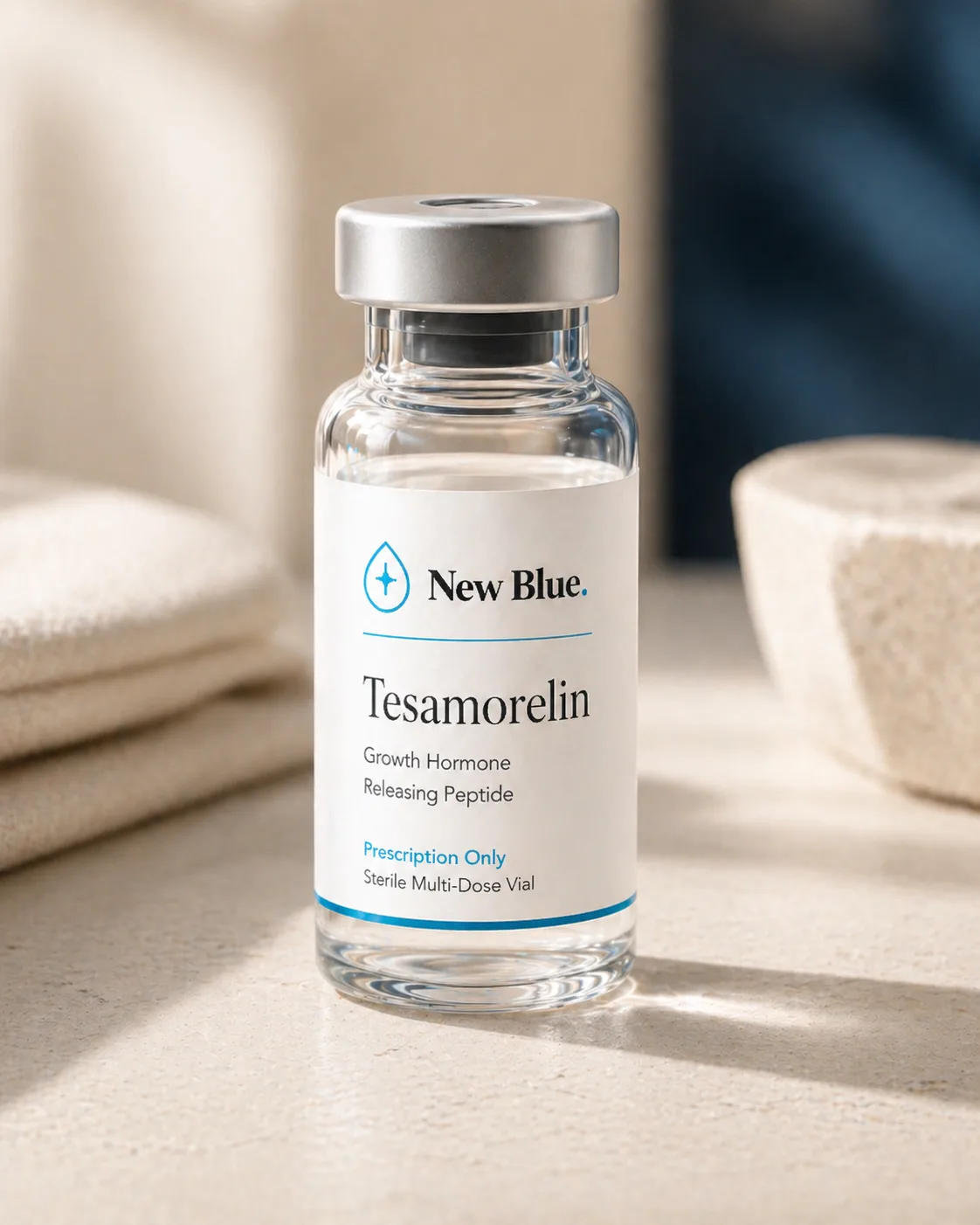
If you've been reading about growth-hormone-supporting peptides and found yourself confused by the overlapping claims, vague descriptions, and contradictory forum posts — you're not alone. The tesamorelin vs sermorelin comparison is one of the most common questions men ask when exploring recovery and performance pathways, yet clear, honest information is surprisingly hard to find. This article draws on published research and the clinical framework used by licensed clinicians who review patients through New Blue Health, a LegitScript-certified telehealth platform, to lay out what actually differs between these two peptides.
What Are Growth-Hormone-Releasing Hormones (GHRH) and Peptide Analogs?
Growth-hormone-releasing hormone (GHRH) is a 44-amino-acid peptide produced in the hypothalamus that signals the anterior pituitary gland to synthesize and secrete growth hormone (GH). Both tesamorelin and sermorelin are synthetic analogs of GHRH — meaning they mimic portions of this natural signaling molecule to stimulate the body's own GH production rather than introducing exogenous growth hormone directly.
This distinction matters. Exogenous GH administration bypasses the pituitary's feedback mechanisms entirely, which is one reason it carries a different risk profile. GHRH analogs, by contrast, work within the hypothalamic-pituitary axis. The pituitary still modulates output based on existing feedback loops, including somatostatin (the hormone that inhibits GH release). That's the theoretical advantage: you're nudging a system rather than overriding it.
But tesamorelin and sermorelin are not interchangeable molecules. They differ in their amino acid sequences, their research histories, the populations they've been studied in, and the clinical contexts where data exists. Understanding those differences is the whole point of this comparison.
Tesamorelin: Mechanism and Published Research
Tesamorelin is a synthetic analog of the full 44-amino-acid GHRH sequence, with a trans-3-hexenoic acid modification at the amino terminus. That modification increases the molecule's resistance to enzymatic degradation, which is a practical way of saying it lasts longer in the body before being broken down.
The most robust clinical data on tesamorelin comes from studies in HIV-positive adults with lipodystrophy — specifically, excess visceral adipose tissue (VAT). Falutz et al. (2007) published a pivotal randomized controlled trial in the New England Journal of Medicine demonstrating that tesamorelin reduced trunk fat by approximately 15% over 26 weeks in this population. A follow-up study by the same group (Falutz et al., 2010) confirmed sustained reductions in VAT with continued use.
Stanley et al. (2014) also investigated tesamorelin's effects on hepatic fat in HIV-infected patients with nonalcoholic fatty liver disease, finding significant reductions in liver fat fraction. More recently, research has explored tesamorelin's potential effects on cognitive function. Cognition-related data, while preliminary, has generated interest — particularly a 2019 study by Baker et al. examining tesamorelin's effects on executive function in older adults at risk for Alzheimer's disease.
It's worth being direct about what this means: the strongest evidence base for tesamorelin is in a specific clinical population (HIV-associated lipodystrophy), and extrapolating those results to the general population requires caution. Licensed clinicians evaluating patients should consider this context. For more detail on the published research, New Blue Health maintains an evidence summary for tesamorelin.
Sermorelin: Mechanism and Published Research
Sermorelin consists of the first 29 amino acids of endogenous GHRH — the biologically active fragment. It was originally investigated in clinical trials for pediatric growth hormone deficiency in the late 1990s, giving it one of the longer track records among GHRH analogs.
Prakash and Goa (1999) published a comprehensive review in BioDrugs covering sermorelin's pharmacology and clinical use in GH-deficient children. The peptide was shown to stimulate pulsatile GH secretion in a pattern closer to physiological norms than exogenous GH injections. Walker (2006) later reviewed sermorelin's broader applications, including its use in diagnostic testing of pituitary GH reserve.
In adult populations, the research is thinner but still informative. Vittone et al. (1997) studied the effects of a single evening dose of a GHRH analog (sermorelin-like) on GH secretion in older men and found increased nocturnal GH pulsatility. This is relevant because age-related decline in GH secretion is driven partly by reduced GHRH signaling and increased somatostatin tone.
Sermorelin's shorter amino acid chain means it is generally less resistant to enzymatic degradation than tesamorelin, which may affect dosing frequency and pharmacokinetics. However, this also means it has been studied at a wider range of doses and in more diverse contexts over a longer period. You can review the evidence summary for sermorelin for additional citations.
Head-to-Head: Key Differences Between Tesamorelin and Sermorelin
Here's where people want a clean comparison, so let's lay it out:
| Feature | Tesamorelin | Sermorelin | |---|---|---| | Amino acid structure | Modified 44-amino-acid GHRH analog | First 29 amino acids of GHRH | | Primary research population | HIV-positive adults with visceral adiposity | Pediatric and adult GH deficiency | | Key published trials | Falutz et al. (2007, 2010); Stanley et al. (2014) | Prakash & Goa (1999); Walker (2006) | | Enzymatic stability | Higher (trans-3-hexenoic acid modification) | Lower (shorter chain, no terminal modification) | | Research on visceral fat | Multiple RCTs showing VAT reduction in HIV population | Limited direct data on visceral fat | | Research on GH pulsatility | Demonstrated in HIV population | Demonstrated in GH-deficient children and older adults | | New Blue Health 30-day pathway | $299 | $279/28-day | | New Blue Health 90-day pathway | $849 | $679 |
A few things stand out. Tesamorelin has stronger published data on visceral fat reduction, but that data is concentrated in a specific clinical population. Sermorelin has a broader (if older) research base and a slightly lower price point through New Blue Health's pathways. Neither peptide should be selected based on price alone — clinical appropriateness, as determined by a licensed clinician, is the deciding factor.
Who Has Each Peptide Been Studied For?
Tesamorelin's clinical trial populations have been predominantly HIV-positive adults experiencing excess visceral adiposity — a condition with metabolic consequences including insulin resistance and cardiovascular risk. The research focus has been relatively narrow but deep, with multiple randomized controlled trials and long-term extension studies.
Sermorelin's research history spans pediatric GH deficiency, adult GH deficiency, diagnostic pituitary testing, and age-related GH decline. The populations are more varied, but the individual studies tend to be smaller and older.
Neither peptide has been extensively studied in healthy, young adults seeking performance enhancement. This is an honest limitation worth acknowledging. Men exploring these pathways through telehealth platforms should discuss their specific goals, health history, and expectations with a licensed clinician who can contextualize the available evidence. New Blue Health's guide on questions to ask before starting peptide therapy is a practical starting point for that conversation.
Compounded Peptides: What That Means and Why It Matters
Both tesamorelin and sermorelin, when obtained through platforms like New Blue Health, are compounded at state-licensed 503A pharmacies. Compounded medications are prepared to order, not commercially manufactured. This is a meaningful distinction.
A 503A compounding pharmacy operates under state board of pharmacy oversight and prepares medications pursuant to individual prescriptions. The compounding process allows for specific formulations — for instance, New Blue Health's sermorelin pathway and tesamorelin pathway are both part of the Recovery/Performance category. But compounded formulations are not evaluated through the same regulatory review process as commercially manufactured drugs. Patients should understand this distinction, and licensed clinicians should explain it during the consultation.
New Blue Health publishes a compounding disclosure that details the sourcing and oversight framework for its pharmacy partners. Andy Palenzuela, the company's founder, has spoken about why this transparency matters: with 14+ years in regulated health product supply chains, he's seen how opacity in sourcing creates real risks for patients. The disclosure page exists specifically to address that gap.
How New Blue Health Approaches Peptide Pathways
New Blue Health is a technology and administrative services platform, not a medical provider. The process works like this: a patient selects a pathway (such as sermorelin or tesamorelin), completes an online intake form, and an independent licensed clinician reviews the case. If appropriate, the clinician may prescribe a treatment, and the compounding pharmacy ships directly to the patient. Pathway prices are all-in with the clinical consultation included — no separate consultation fee, no membership fee, no forced subscription. If a clinician determines treatment isn't appropriate, you're refunded your payment minus a $75 clinical consultation (non-refundable because the clinical review was performed). For the 30-day tesamorelin pathway ($299), that's a $224 refund; for the 30-day sermorelin pathway ($279/28-day), that's a $204 refund. Services are available in 48 states (Alabama and Mississippi excluded). All content published by the platform is reviewed according to its medical review policy.
Questions to Discuss With Your Clinician
Before starting any peptide pathway, consider bringing these questions to your consultation:
- What does my health history suggest about whether tesamorelin or sermorelin might be more appropriate — or whether neither is suitable?
- How does the published research apply (or not apply) to someone with my profile?
- What monitoring or follow-up should I expect?
- What are the known side effects, and what should prompt me to stop and seek care?
- How does compounded medication sourcing differ from commercially manufactured products?
These aren't hypothetical. They're the kinds of questions that separate an informed patient from someone who picked a peptide based on a Reddit thread.
Making an Informed Decision
The tesamorelin vs sermorelin comparison doesn't have a universal winner. Tesamorelin has more robust trial data on visceral fat reduction in a specific population. Sermorelin has a longer and broader research history with a slightly different clinical profile. Both are GHRH analogs that stimulate endogenous GH production rather than replacing it.
The right choice — if either is appropriate — depends on individual clinical factors that only a licensed clinician can evaluate after reviewing your intake, history, and goals. That evaluation is the part that matters most, and it's the part no blog post can replace.
Frequently Asked Questions
What is the main difference between tesamorelin and sermorelin?
Tesamorelin is a modified 44-amino-acid GHRH analog studied primarily in HIV-associated visceral adiposity (Falutz et al., 2007). Sermorelin corresponds to the first 29 amino acids of endogenous GHRH and has a longer research history in growth hormone deficiency contexts. A licensed clinician can help determine which, if either, may be appropriate based on individual clinical review.
What is the regulatory status of compounded medications?
Compounded versions of tesamorelin and sermorelin are prepared at state-licensed 503A compounding pharmacies and are not commercially manufactured drug products. There is a meaningful distinction between branded, commercially manufactured products and compounded formulations prepared pursuant to individual prescriptions. Your clinician and pharmacist can provide more detail on what this means for your care.
Does everyone qualify for peptide therapy through New Blue Health?
No. Eligibility depends on clinical review by an independent licensed clinician. New Blue Health is a technology and administrative services platform, not a medical provider. If appropriate, a licensed clinician may prescribe a treatment pathway based on individual evaluation.
How much does a consultation cost through New Blue Health?
The price is all-in and includes the clinical consultation — no separate consultation fee, no membership fee, no forced subscription. If a clinician doesn't prescribe, you're refunded your payment minus a $75 clinical consultation — e.g., a $224 refund on the 30-day tesamorelin pathway ($299) or a $204 refund on the 30-day sermorelin pathway ($279/28-day). Consultation timing varies by clinician availability.
Is New Blue Health available in my state?
New Blue Health's services are available in 48 states, subject to pathway, pharmacy, and provider availability. Alabama and Mississippi are not currently served. If you are unsure about availability for a specific pathway in your state, you can reach out through the contact page for clarification.
Medical Disclaimer: This article is for informational purposes only and does not constitute medical advice, diagnosis, or treatment. All clinical decisions should be made by a licensed clinician based on individual patient evaluation. New Blue Health is a technology and administrative services platform, not a medical provider. Individual results vary, and no specific outcomes can be promised. Consult a qualified healthcare professional before starting any new treatment.
Written by Andy Palenzuela — founder of New Blue Health, with 14+ years in regulated health product supply chains. Clinical content reviewed by the New Blue Health Clinical Content Team.
<!--SCHEMA_JSONLD [ { "@context": "https://schema.org", "@type": "Article", "headline": "Tesamorelin vs Sermorelin: How These Two Growth-Hormone-Supporting Peptides Differ", "description": "Explore the differences between tesamorelin and sermorelin — two growth-hormone-supporting peptides. Learn how each works, who they're studied for, and how to discuss options with a licensed clinician through New Blue Health. Pathways starting at all-in pricing (clinical consultation included).", "author": { "@type": "Person", "name": "Andy Palenzuela", "url": "[About New Blue Health](/about)" }, "publisher": { "@type": "Organization", "name": "New Blue Health", "url": "https://newbluehealth.com" }, "datePublished": "2025-01-31", "dateModified": "2025-01-31", "mainEntityOfPage": { "@type": "WebPage", "@id": "[Tesamorelin vs Sermorelin](/compare/tesamorelin-vs-sermorelin)" } }, { "@context": "https://schema.org", "@type": "FAQPage", "mainEntity": [ { "@type": "Question", "name": "What is the main difference between tesamorelin and sermorelin?", "acceptedAnswer": { "@type": "Answer", "text": "Tesamorelin is a modified 44-amino-acid GHRH analog studied primarily in HIV-associated visceral adiposity (Falutz et al., 2007). Sermorelin corresponds to the first 29 amino acids of endogenous GHRH and has a longer research history in growth hormone deficiency contexts. A licensed clinician can help determine which, if either, may be appropriate based on individual clinical review." } }, { "@type": "Question", "name": "What is the regulatory status of compounded medications?", "acceptedAnswer": { "@type": "Answer", "text": "Compounded versions of tesamorelin and sermorelin are prepared at state-licensed 503A compounding pharmacies and are not commercially manufactured drug products. There is a meaningful distinction between branded, commercially manufactured products and compounded formulations prepared pursuant to individual prescriptions. Your clinician and pharmacist can provide more detail on what this means for your care." } }, { "@type": "Question", "name": "Does everyone qualify for peptide therapy through New Blue Health?", "acceptedAnswer": { "@type": "Answer", "text": "No. Eligibility depends on clinical review by an independent licensed clinician. New Blue Health is a technology and administrative services platform, not a medical provider. If appropriate, a licensed clinician may prescribe a treatment pathway based on individual evaluation." } }, { "@type": "Question", "name": "How much does a consultation cost through New Blue Health?", "acceptedAnswer": { "@type": "Answer", "text": "The price is all-in and includes the clinical consultation — no separate consultation fee, no membership fee, no forced subscription. If a clinician doesn't prescribe, you're refunded your payment minus a $75 clinical consultation — e.g., a $224 refund on the 30-day tesamorelin pathway ($299) or a $204 refund on the 30-day sermorelin pathway ($279/28-day). Consultation timing varies by clinician availability." } }, { "@type": "Question", "name": "Is New Blue Health available in my state?", "acceptedAnswer": { "@type": "Answer", "text": "New Blue Health's services are available in 48 states, subject to pathway, pharmacy, and provider availability. Alabama and Mississippi are not currently served. If you are unsure about availability for a specific pathway in your state, you can reach out through the contact page for clarification." } } ] }, { "@context": "https://schema.org", "@type": "MedicalWebPage", "about": { "@type": "MedicalCondition", "name": "Growth Hormone Deficiency and Related Conditions" }, "headline": "Tesamorelin vs Sermorelin: How These Two Growth-Hormone-Supporting Peptides Differ", "lastReviewed": "2025-01-31", "url": "[Tesamorelin vs Sermorelin](/compare/tesamorelin-vs-sermorelin)" } ] -->Medical review & editorial standards
This page is educational content from the New Blue Health Clinical Content Team. It is reviewed under the New Blue Health Medical Review Policy and Editorial Policy and should not replace individualized medical advice from a licensed clinician. For how we evaluate evidence, see Evidence Methodology and Clinical Sources & References.