Medical Disclaimer: This article is for informational purposes only and does not constitute medical advice, diagnosis, or treatment. All medical decisions should be made by a licensed clinician based on individual health circumstances. Never start, stop, or change a medication without consulting a qualified healthcare professional. New Blue Health is a technology and administrative services platform, not a medical provider.
Prescription-Strength GHK-Cu vs. OTC Copper Peptides: What Men Should Know
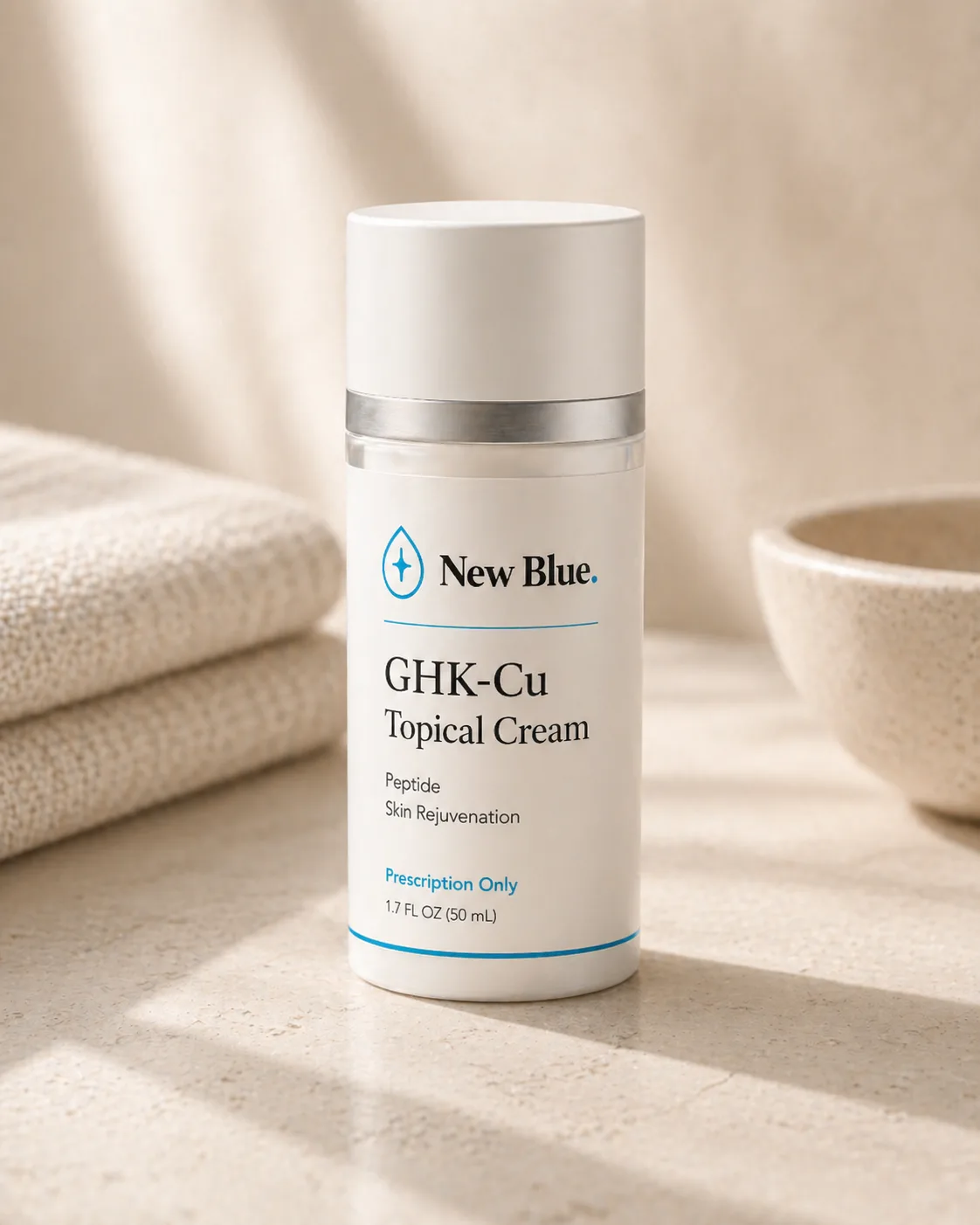
If you've spent any time researching copper peptides for skin repair, hair thinning, or tissue recovery, you've probably noticed a confusing split: drugstore serums labeled "copper peptide complex" sitting alongside clinical discussions about prescription-strength GHK-Cu compounded at licensed pharmacies. The two categories share a molecule in name but differ substantially in concentration, formulation, regulatory pathway, and how they reach you. This article breaks down those differences using published research, specific product details, and the clinical review process involved when prescription GHK-Cu is considered — drawing on 14 years of experience in regulated health product supply chains.
What Is GHK-Cu? A Brief Overview of Copper Peptides
GHK-Cu (glycyl-L-histidyl-L-lysine copper complex) is a naturally occurring tripeptide-copper complex first isolated from human plasma by Pickart and Thaler in 1973. It exists in your bloodstream at measurable concentrations that decline with age — plasma levels drop from roughly 200 ng/mL at age 20 to approximately 80 ng/mL by age 60, according to Pickart's later work (2008).
The molecule binds copper(II) ions with high affinity, and that copper-peptide bond is what distinguishes GHK-Cu from generic "copper peptide" marketing language. Many OTC products use various copper-binding peptides or copper salts without specifying the exact tripeptide sequence. GHK-Cu specifically refers to the Gly-His-Lys sequence chelated to a copper ion — a distinction that matters because the biological activity studied in peer-reviewed literature is tied to that specific structure.
Copper peptides as a broad category have been used in cosmetics since the 1990s. But the clinical investigation of GHK-Cu as a defined compound — particularly at higher concentrations and in non-cosmetic formulations — is a more recent and more specific area of research. For a deeper look at the evidence base, New Blue Health maintains a dedicated GHK-Cu evidence summary.
How GHK-Cu Works: Proposed Mechanisms of Action
GHK-Cu appears to influence tissue biology through multiple signaling pathways rather than a single receptor interaction. Research by Pickart, Vasquez-Soltero, and Margolina (2015) identified that GHK-Cu modulates the expression of over 4,000 human genes, with notable effects on genes involved in collagen synthesis, antioxidant defense, and inflammatory response.
Three proposed mechanisms deserve specific mention:
Collagen remodeling. GHK-Cu has been investigated for its role in stimulating collagen I and III synthesis while also promoting the activity of matrix metalloproteinases (MMPs), which break down damaged extracellular matrix. This dual action — building new collagen while clearing damaged tissue — is what differentiates it from simple collagen-boosting ingredients. Park et al. (2009) demonstrated increased collagen production in dermal fibroblasts exposed to GHK-Cu in vitro.
Anti-inflammatory signaling. Canapp et al. (2003) found that GHK-Cu reduced markers of inflammation in wound models, suggesting a role in modulating the inflammatory phase of tissue repair rather than simply suppressing it.
Antioxidant gene expression. The tripeptide has been shown to upregulate superoxide dismutase (SOD) and other endogenous antioxidant enzymes. This is mechanistically distinct from applying an external antioxidant like vitamin C — GHK-Cu appears to signal your cells to produce more of their own protective enzymes.
None of this means GHK-Cu is a guaranteed solution for any condition. Individual responses vary, and the gap between in vitro findings and real-world clinical outcomes is always significant. But the mechanistic picture is more detailed than what you'll find for most peptides in the cosmetic or wellness space.
Prescription-Strength GHK-Cu vs. OTC Copper Peptide Products
This is the core distinction most people searching for "prescription GHK-Cu therapy" are trying to understand. The differences are not trivial.
| Factor | OTC Copper Peptide Products | Prescription-Strength GHK-Cu | |---|---|---| | Concentration | Typically 0.01%–0.1% (often undisclosed) | Available in defined concentrations (e.g., 0.2%, 2%, 4%) | | Formulation control | Cosmetic-grade manufacturing | Compounded at state-licensed 503A pharmacies | | Clinician involvement | None required | Requires clinical review and prescription | | Peptide identity verification | Varies; often proprietary blends | Specific GHK-Cu tripeptide, pharmacy-verified | | Regulatory pathway | Cosmetic regulations (minimal) | Pharmacy compounding under state and federal oversight | | Cost range | $15–$80 per bottle | $229–$369 per unit (all-in; clinical consultation included) |
The concentration gap is the most practically significant difference. A typical OTC serum might contain copper peptides at concentrations below 0.1%, often blended with other actives that may or may not interact favorably. Prescription-strength GHK-Cu cream through platforms like New Blue Health is available at 0.2%, 2%, or 4% concentrations — the 4% formulation representing a 40-fold or greater increase over many OTC products.
Whether that concentration difference translates to proportionally better outcomes for any given individual is a clinical question, not a marketing one. That's precisely why a licensed clinician reviews each case before determining whether a prescription is appropriate.
What Does Clinician-Guided GHK-Cu Therapy Involve?
Clinician-guided GHK-Cu therapy means a licensed, independent clinician evaluates whether prescription-strength GHK-Cu is appropriate for you before anything is prescribed or shipped. This is not a rubber-stamp process.
Through New Blue Health's platform, the process works like this: you select a treatment pathway, complete a detailed health intake, and pay one all-in price that already includes the $75 clinical consultation — there is no separate consultation fee. An independent licensed clinician then reviews your intake — including health history, current medications, and relevant conditions. If the clinician determines that GHK-Cu therapy is appropriate, a prescription is issued to a state-licensed 503A compounding pharmacy, which prepares and ships the medication directly to you.
If the clinician determines it's not appropriate, no prescription is written. In that case you’re refunded your payment minus the $75 clinical consultation (a $154 refund on the $229 pathway), because the clinical work — the review itself — has been performed regardless of outcome.
This structure exists because compounded medications require prescriptions. Unlike grabbing a copper peptide serum off a shelf, prescription GHK-Cu involves a medical decision made by a licensed professional. New Blue Health facilitates the administrative and technology side of that process but does not make medical decisions. The editorial policy page outlines how clinical content and care coordination are kept separate.
What Clinical Review Covers Before GHK-Cu Is Considered
The clinical review isn't just a formality. Licensed clinicians evaluate several factors before considering GHK-Cu therapy:
- Current medications and supplements — copper interacts with certain chelating agents and zinc supplementation, among other things.
- Existing skin conditions — active infections, open wounds in the application area, or conditions like eczema may affect whether topical GHK-Cu is appropriate.
- Medical history — conditions affecting copper metabolism (such as Wilson's disease) would be relevant contraindications.
- Goals and expectations — a clinician assessing whether GHK-Cu is appropriate also considers whether the patient's expectations align with what the evidence supports.
This review happens through the telehealth consultation. It's worth understanding that "telehealth" here doesn't mean chatting with a bot. It means a licensed clinician — a real person with prescriptive authority — making a judgment call based on your specific situation.
Who Researches GHK-Cu Therapy and Why
Most of the foundational GHK-Cu research traces back to Loren Pickart, PhD, who first identified the molecule and has published extensively on its biological roles over several decades. More recent work has expanded into wound healing (Arul et al., 2005), hair follicle biology, and broader tissue remodeling contexts.
Men specifically tend to research GHK-Cu for three reasons: hair thinning, post-procedure skin recovery, and general skin quality as they age. The hair-related interest stems from studies like those by Pyo et al. (2007), which found that GHK-Cu stimulated hair follicle cell proliferation in vitro. Again — in vitro is not the same as clinical proof in humans, but it provides a mechanistic rationale that drives further investigation.
The broader peptide therapy landscape has grown substantially, and GHK-Cu sits in a category alongside other compounds being studied for recovery and cellular health. New Blue Health's platform also offers pathways for sermorelin, NAD+, and other peptides — each with its own evidence base and clinical review requirements.
GHK-Cu and the Broader Peptide Therapy Landscape
GHK-Cu occupies a specific niche. It's topical (in New Blue Health's current offerings), targeted primarily at skin and hair, and available in cream formulations at three concentration tiers: 0.2% ($229), 2% ($324), and 4% ($369) — one honest all-in price per tier, with the $75 clinical consultation included rather than added on top.
This positions it differently from injectable peptides like sermorelin or systemic compounds like NAD+. If you're evaluating multiple peptide pathways, the guide on questions to ask before starting peptide therapy is a practical starting point for understanding what to discuss with a clinician.
Safety Considerations and What the Research Says
GHK-Cu has a generally favorable safety profile in the published literature, particularly in topical applications. Pickart (2008) noted minimal adverse effects in studies of topical GHK-Cu at various concentrations. However, "generally favorable" is not the same as "risk-free for everyone."
Copper overload is a theoretical concern, particularly at higher concentrations or with prolonged use, though topical absorption of copper from GHK-Cu cream has not been shown to produce systemic copper toxicity in published studies to date. Individuals with copper metabolism disorders should not use GHK-Cu without explicit medical guidance.
Skin irritation, redness, or sensitivity reactions are possible with any topical active, particularly at higher concentrations. The 4% formulation represents a significantly more potent preparation than most people have encountered in OTC products, and a clinician's assessment of skin tolerance is part of the review process.
New Blue Health's safety policy details how adverse events are handled and reported through the platform.
How New Blue Health Approaches This
New Blue Health is a LegitScript-certified technology and administrative services platform, not a medical provider. It connects patients with independent licensed clinicians and state-licensed 503A compounding pharmacies. Andy Palenzuela founded the company after 14 years working in regulated health product supply chains, with a focus on building transparent pricing and verifiable sourcing into the telehealth model. Every GHK-Cu pathway is one honest all-in price that includes the telehealth consultation, prescription (if appropriate), medication, supplies, and shipping — the $75 clinical consultation is included, not a separate fee. If a clinician doesn’t prescribe, you’re refunded your payment minus the $75 clinical consultation (a $154 refund on the $229 pathway). The platform is available in 48 states (Alabama and Mississippi excluded).
Frequently Asked Questions
Is prescription GHK-Cu the same as the copper peptide serums sold over the counter?
No. OTC copper peptide products are typically cosmetic-grade topical serums with lower concentrations. Prescription-strength GHK-Cu is compounded at state-licensed 503A pharmacies under a clinician's order and may be available in different formulations and concentrations. The two are not interchangeable.
Does everyone qualify for prescription GHK-Cu therapy?
No. Eligibility depends on clinical review by an independent licensed clinician who evaluates your health history, current medications, and individual circumstances. Not everyone qualifies, and the clinician makes the final medical decision.
What is the regulatory status of compounded medications?
Compounded medications, including compounded GHK-Cu, are prepared at state-licensed 503A compounding pharmacies under applicable state and federal regulations. They are prepared to order, not commercially manufactured. This is standard for all compounded medications.
What role does New Blue Health play in GHK-Cu therapy?
New Blue Health is a technology and administrative services platform — not a medical provider and not a pharmacy. New Blue facilitates patient intake, payment, and care coordination. Medical services are provided by independent licensed medical groups, and medications, if prescribed, are prepared and shipped by state-licensed 503A compounding pharmacies.
Is GHK-Cu pricing all-in, and is the clinical consultation included?
The price is all-in and already includes the $75 clinical consultation — it is not added on top. If a clinician doesn’t prescribe, you’re refunded your payment minus the $75 clinical consultation (a $154 refund on the $229 pathway), because the clinical review was performed. Consultation timing varies by clinician availability.
Medical Disclaimer: This article is for informational purposes only and does not constitute medical advice, diagnosis, or treatment. All medical decisions should be made by a licensed clinician based on individual health circumstances. New Blue Health is a technology and administrative services platform, not a medical provider. Individual results vary, and no specific outcomes can be promised. Compounded medications are not commercially manufactured pharmaceutical products.
Written by Andy Palenzuela — founder of New Blue Health, with 14+ years in regulated health product supply chains. Clinical content reviewed in accordance with New Blue Health's clinical content team standards.
<!--SCHEMA_JSONLD [ { "@context": "https://schema.org", "@type": "Article", "headline": "Prescription-Strength GHK-Cu vs. OTC Copper Peptides: What Men Should Know", "description": "Learn how prescription-strength GHK-Cu differs from OTC copper peptides, what clinician-guided therapy involves, and how to explore options through a telehealth platform. Pathways starting at posted all-in pricing (clinical consultation included).", "author": { "@type": "Person", "name": "Andy Palenzuela" }, "publisher": { "@type": "Organization", "name": "New Blue Health", "url": "https://newbluehealth.com" }, "datePublished": "2025-01-31", "dateModified": "2025-01-31", "mainEntityOfPage": "https://newbluehealth.com/prescription-ghk-cu-therapy-explained" }, { "@context": "https://schema.org", "@type": "FAQPage", "mainEntity": [ { "@type": "Question", "name": "Is prescription GHK-Cu the same as the copper peptide serums sold over the counter?", "acceptedAnswer": { "@type": "Answer", "text": "No. OTC copper peptide products are typically cosmetic-grade topical serums with lower concentrations. Prescription-strength GHK-Cu is compounded at state-licensed 503A pharmacies under a clinician's order and may be available in different formulations and concentrations. The two are not interchangeable." } }, { "@type": "Question", "name": "Does everyone qualify for prescription GHK-Cu therapy?", "acceptedAnswer": { "@type": "Answer", "text": "No. Eligibility depends on clinical review by an independent licensed clinician who evaluates your health history, current medications, and individual circumstances. Not everyone qualifies, and the clinician makes the final medical decision." } }, { "@type": "Question", "name": "What is the regulatory status of compounded medications?", "acceptedAnswer": { "@type": "Answer", "text": "Compounded medications, including compounded GHK-Cu, are prepared at state-licensed 503A compounding pharmacies under applicable state and federal regulations. They are prepared to order, not commercially manufactured. This is standard for all compounded medications." } }, { "@type": "Question", "name": "What role does New Blue Health play in GHK-Cu therapy?", "acceptedAnswer": { "@type": "Answer", "text": "New Blue Health is a technology and administrative services platform — not a medical provider and not a pharmacy. New Blue facilitates patient intake, payment, and care coordination. Medical services are provided by independent licensed medical groups, and medications, if prescribed, are prepared and shipped by state-licensed 503A compounding pharmacies." } }, { "@type": "Question", "name": "Is GHK-Cu pricing all-in, and is the clinical consultation included?", "acceptedAnswer": { "@type": "Answer", "text": "The price is all-in and already includes the $75 clinical consultation — it is not added on top. If a clinician doesn’t prescribe, you’re refunded your payment minus the $75 clinical consultation (a $154 refund on the $229 pathway), because the clinical review was performed. Consultation timing varies by clinician availability." } } ] }, { "@context": "https://schema.org", "@type": "MedicalWebPage", "about": { "@type": "MedicalTherapy", "name": "GHK-Cu Copper Peptide Therapy" }, "lastReviewed": "2025-01-31" } ] -->
Medical review & editorial standards
This page is educational content from the New Blue Health Clinical Content Team. It is reviewed under the New Blue Health Medical Review Policy and Editorial Policy and should not replace individualized medical advice from a licensed clinician. For how we evaluate evidence, see Evidence Methodology and Clinical Sources & References.