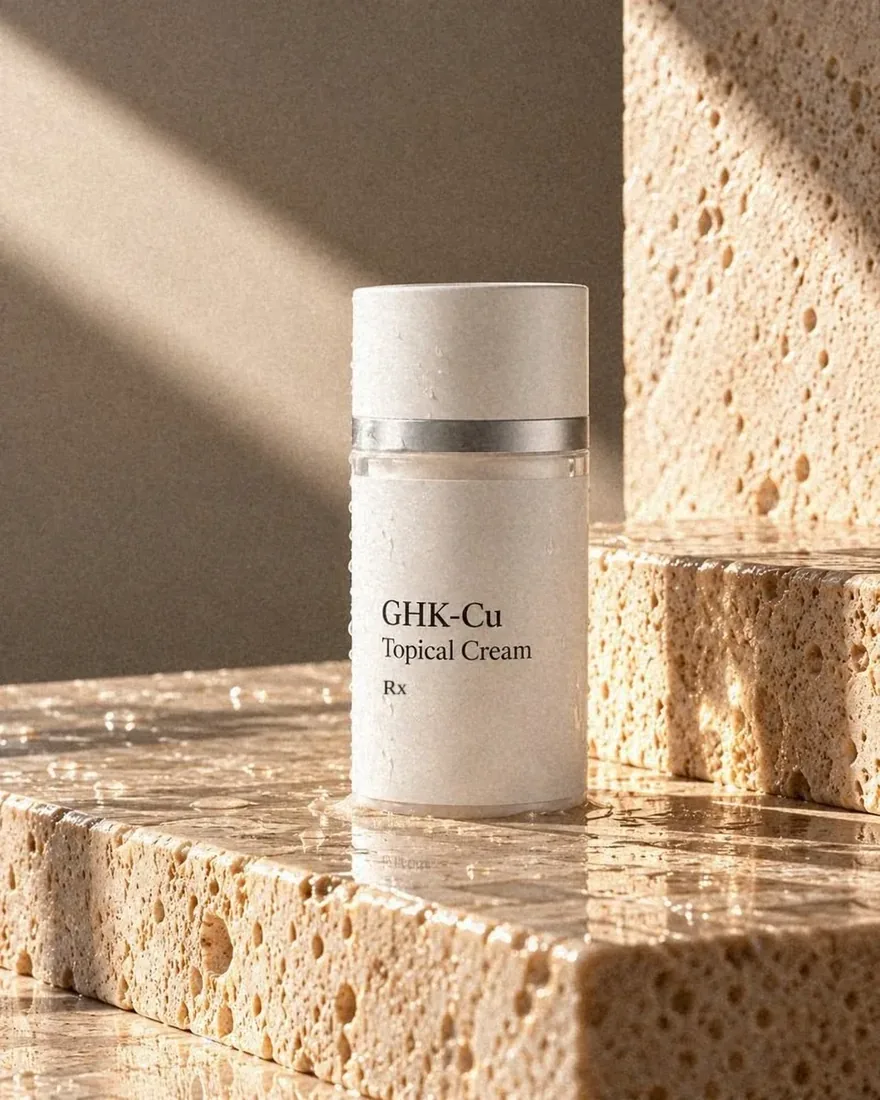
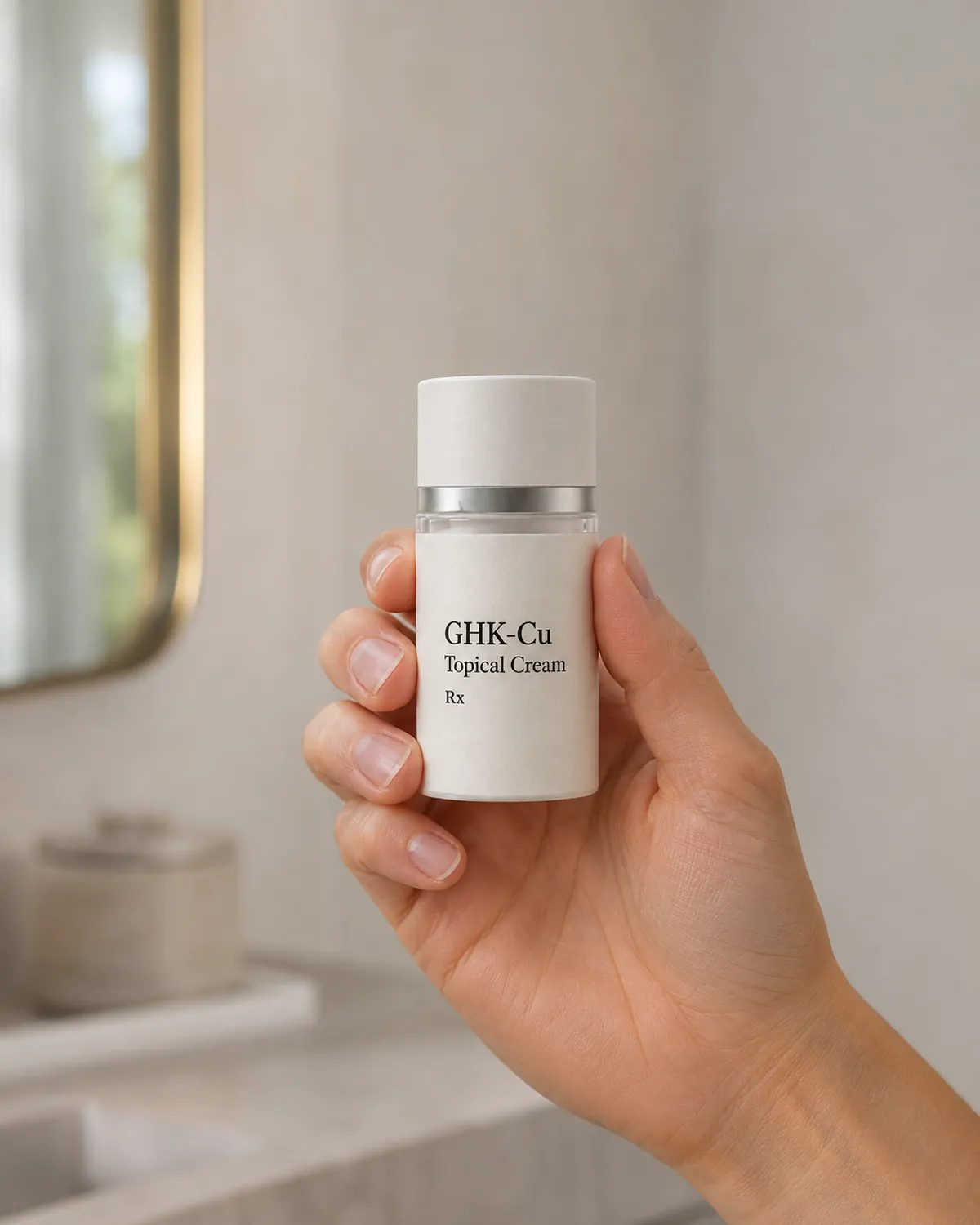
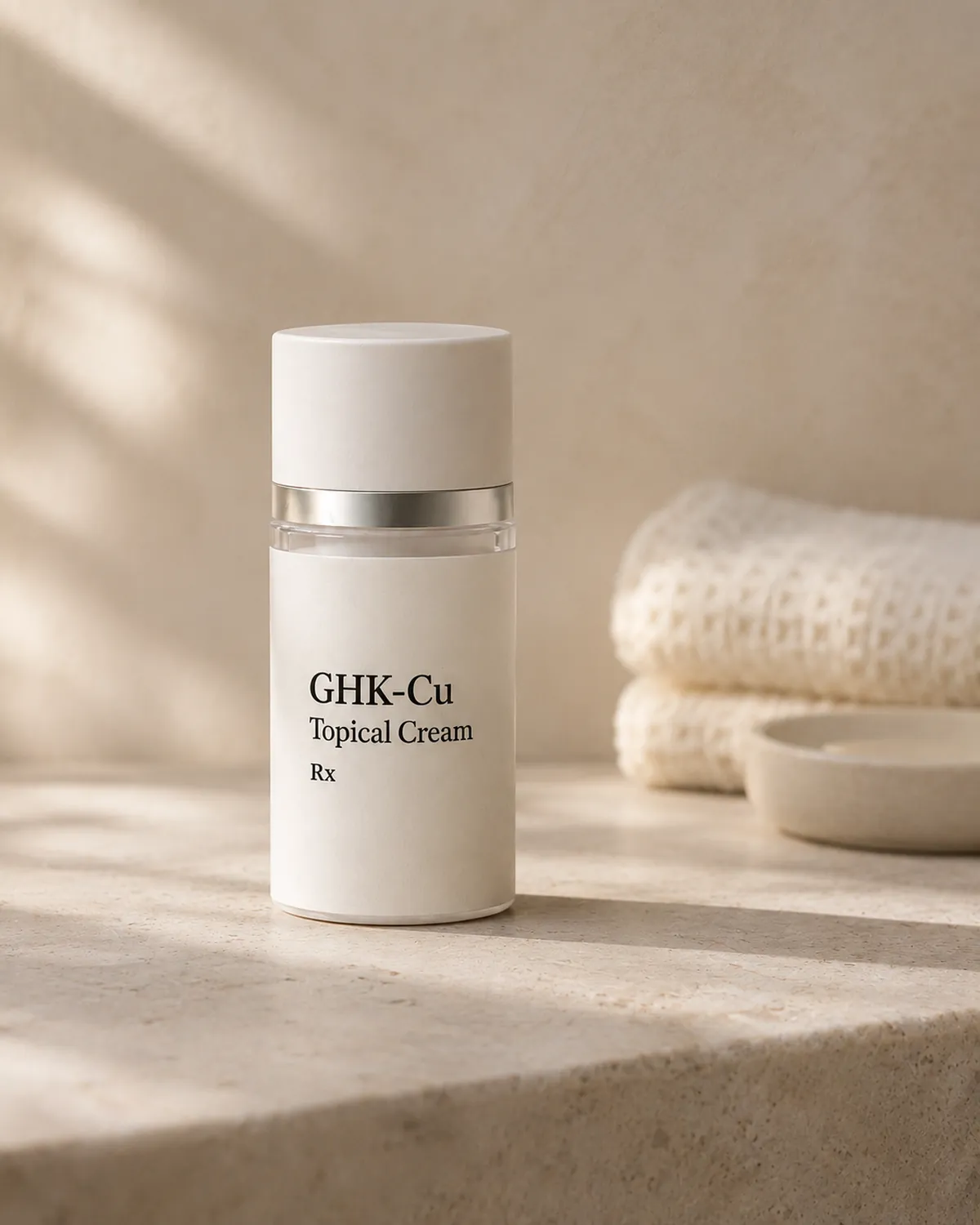
Start your visitIf prescribed. Vials and bottles may look different depending on the pharmacy.
GHK-Cu
Copper peptide Cream
A prescription cream with the copper peptide GHK-Cu, applied to the skin.
Adults 21+ interested in clinician-guided skin or hair support may want to discuss it. Available only if prescribed by an independent licensed clinician, after a short online visit.
Starts with a secure online intake about your health history and goals.
Both plans include the $75 clinician review, medication if prescribed and shipping to your door.
No charge until your request is accepted for clinician review.
Not prescribed? You get 100% back: all $450. The only exception is where state rules require a video visit (Arkansas, Kansas, New Jersey, New Mexico, Rhode Island and West Virginia). There, $75 pays for that visit and the other $375 is refunded.
Available in 48 states. Adults 21 and over. Only when clinically appropriate.Never guaranteed. Compounded medications are not FDA-approved. Check availability in your state
How it works
How a GHK-Cu request works
1
Complete a secure online intake about your health history and goals.
Today, online. Includes a photo ID.
2
An independent licensed clinician reviews your intake to see whether GHK-Cu is appropriate for you.
Typically reviewed in 12 to 36 hours. A few states require a video visit instead. You’ll see that before you pay.
3
If prescribed, your medication ships from a licensed partner pharmacy.
Typically 2 to 3 days at the pharmacy, then 1 to 2 days in transit.
Typical times, not promises. Only when clinically appropriate. Never guaranteed.
Prescriptions are filled by licensed U.S. pharmacies. Compounded medications are prepared by state-licensed 503A compounding pharmacies or FDA-registered 503B outsourcing facilities. Compounded medications are not FDA-approved.
Packaging may look different depending on the pharmacy.
Delivered to your door, if prescribed.
What you pay
$450, one payment for 3 months.
Your card
Held today, not charged. The hold becomes a charge when your request is accepted for clinician review.
Not prescribed?
You get 100% back: all $450. The only exception is where state rules require a video visit (Arkansas, Kansas, New Jersey, New Mexico, Rhode Island and West Virginia). There, $75 pays for that visit and the other $375 is refunded. Refund policy
After that
Nothing renews automatically, and there’s no membership. You’re charged again only if you choose to order more.
New Blue Health is a technology and administrative services platform: it runs the website, your account, payments and support. An independent licensed clinician reviews your request. Only a clinician can prescribe. A licensed partner pharmacy prepares your medication, if prescribed.
Privacy
No advertising pixels and no third-party analytics. We don’t sell your personal or health information.
Vials and bottles may look different depending on the pharmacy.
Good to know
What arrives, if prescribed.
Topical cream
Applied to the skin, as prescribed after clinician review.
Strengths
1%, 3% or 5%. A clinician reviews whether the strength you choose is appropriate.
Pharmacy
A licensed partner pharmacy fills your prescription, if prescribed.
Shipping
To your door, with tracking in your account.
Storage
Store as labeled.
Vials and bottles may look different depending on the pharmacy.
Only when clinically appropriate. Never guaranteed.
Frequently asked questions
Write to support@newbluehealth.com. The New Blue team answers Monday to Friday, 9 a.m. to 6 p.m. Eastern, within one business day. Medical questions are passed to your clinician.
Not for emergencies: in a medical emergency, call 911.
How is this different from over-the-counter copper peptide products?
The main difference is usually formulation and clinician oversight, not a promise of guaranteed clinical superiority. Practical use, irritation risk, and expectations still need review.
Can I use GHK-Cu on my scalp for hair-support goals?
That may be part of a clinician-guided discussion, but hair-support claims should stay cautious because evidence remains limited.
Who may want to discuss GHK-Cu topical therapy with a clinician?
Adults 21+ interested in clinician-guided skin or hair support may want to discuss GHK-Cu topical therapy. Fit depends on skin goals, scalp or skin sensitivity, current topical regimen, and the overall treatment plan.
Are there side effects?
Topical irritation or sensitivity is possible. Review current products, allergy history, and what should prompt a pause before you begin.
What should I review with my clinician before starting GHK-Cu topical therapy?
Review current skin or hair products, history of irritation or allergy, target treatment areas, and how consistently you can follow the regimen. Your clinician should discuss application instructions, what irritation should trigger a pause, and when to re-check progress.
How long until I see results?
Visible changes vary by person, treatment area, consistency, and the limits of the evidence base. Outcomes are not guaranteed.
When should I contact my clinician or seek urgent care?
Severe or worsening symptoms, signs of allergic reaction, chest pain, trouble breathing, neurologic symptoms, or inability to keep fluids down should prompt urgent evaluation. Telehealth is not emergency care. Call 911 or go to the nearest emergency department for life-threatening symptoms.
Are results guaranteed?
No. Eligibility, tolerability, and outcomes vary by person. Prescriptions are never automatic or guaranteed, and treatment decisions are made by a licensed clinician based on your history, current medications, contraindications, and goals.
How much does GHK-Cu cream cost?
GHK-Cu cream is from $150/mo, $450 for 3 months. Both plans include the $75 clinician review, medication if prescribed and shipping to your door. Available only if prescribed by an independent licensed clinician.
GHK-Cu cream 1%, 3 months: $450 total ($150/mo), one payment. Nothing renews automatically. Not prescribed? You get 100% back: all $450. The only exception is where state rules require a video visit (Arkansas, Kansas, New Jersey, New Mexico, Rhode Island and West Virginia). There, $75 pays for that visit and the other $375 is refunded. Only when clinically appropriate. Never guaranteed.
GHK-Cu is a copper-peptide complex discussed in topical skin and hair support conversations. Most evidence is small, mechanistic, or early-stage, so claims should remain cautious and clinician-guided.
GHK-Cu is studied for skin and tissue signaling, and it may be discussed for skin-texture or hair-support goals. That does not make collagen, elastin, hair growth, or wound-healing outcomes established clinical facts for every use case. Practical topical use, irritation risk, and realistic expectations matter.
If the broader conversation is body composition rather than skin or hair support, a different pathway may be more appropriate.
02
Why patients explore GHK-Cu
Studied for skin and tissue signaling
Most evidence is mechanistic or early-stage, so benefits should be described cautiously.
Discussed for skin-texture goals
Topical use may be reviewed when patients want practical skin-support discussions beyond over-the-counter routines.
Discussed for hair-support goals
Some patients review GHK-Cu in scalp-care conversations, but evidence remains limited.
Evidence remains limited
Small studies and mechanistic theory should not be treated as guaranteed outcome data.
Who it’s built for
Adults interested in clinician-guided topical skin-support discussions
Patients who want hair-support goals reviewed conservatively
Individuals who prefer a topical plan over injectable therapies
Patients who want evidence limits stated clearly before use
Review current skin or hair products, history of irritation or allergy, target treatment areas, and how consistently you can follow the regimen. Your clinician should discuss application instructions, what irritation should trigger a pause, and when to re-check progress.
Your clinician may review current skin or hair products, irritation history, and the target treatment areas before starting.
Application instructions, dosing cadence, and how consistently you can follow the regimen should be discussed up front.
Scalp or skin sensitivity, allergy history, and when irritation should prompt a pause are important monitoring topics.
Use Evidence Methodology and Sources if you want to understand how New Blue frames limited or mechanistic evidence.