Medical Disclaimer: This article is for informational purposes only and does not constitute medical advice, diagnosis, or treatment. All clinical decisions are made by independent licensed clinicians. Consult a qualified healthcare professional before starting any therapy. New Blue Health is a technology and administrative services platform, not a medical provider.
NAD+ Therapy for Energy and Healthy Aging: What Adults Over 40 Should Know
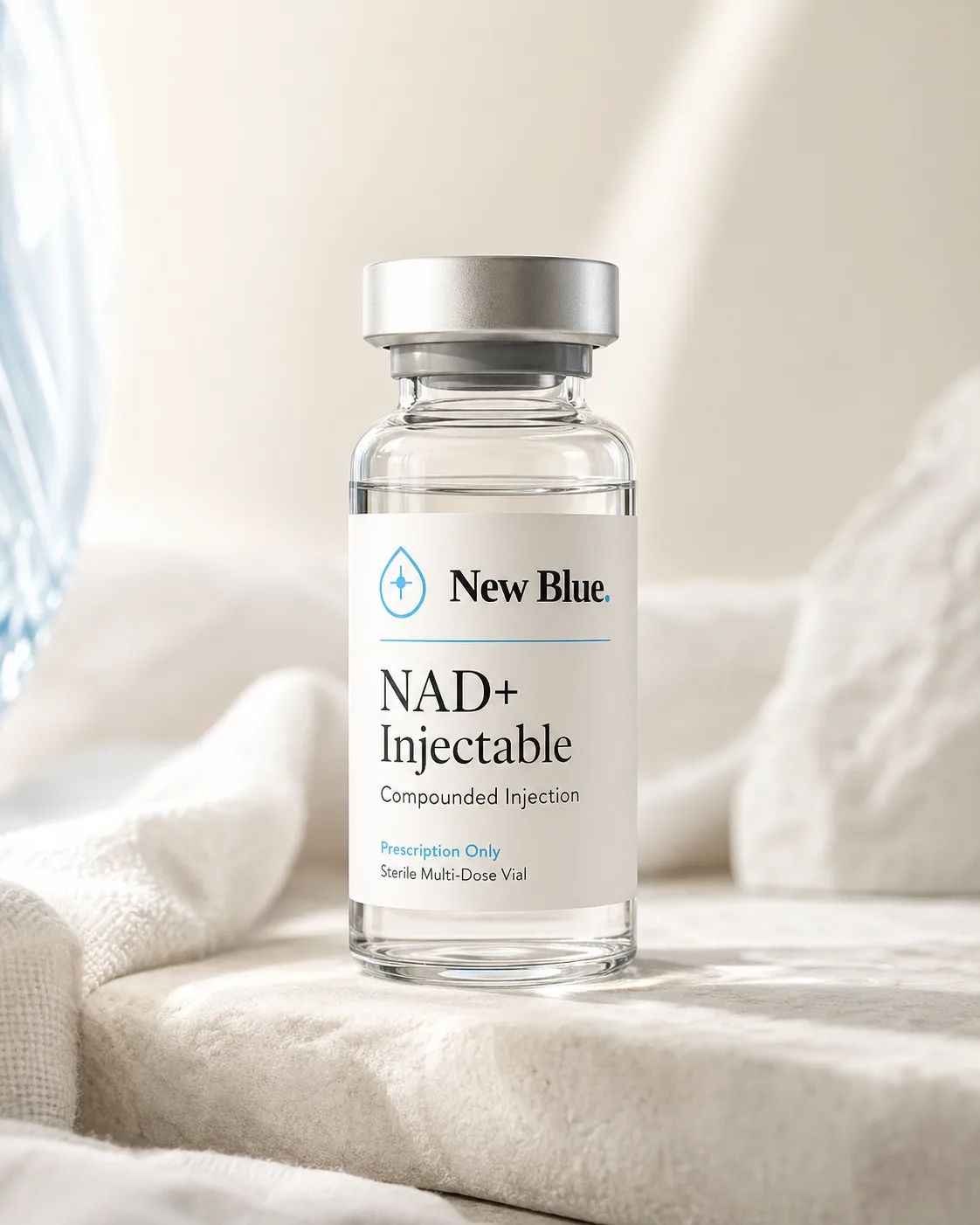
If you're over 40 and noticing that your energy isn't what it used to be—or that recovery from workouts, travel, or even a bad night's sleep takes longer than it should—you've probably encountered NAD+ somewhere in your reading. The problem is that most of what's written about NAD+ online falls into one of two camps: breathless hype or impenetrable biochemistry. This article sits in neither camp. It's built on published research, reviewed against New Blue Health's editorial standards, and written by someone who has spent over 14 years working in regulated health product supply chains.
What Is NAD+ and Why Does It Matter?
NAD+ (nicotinamide adenine dinucleotide) is a coenzyme present in every living cell, and it is essential for converting nutrients into usable cellular energy. Without adequate NAD+, mitochondria—the structures inside cells responsible for producing ATP—cannot function efficiently. It also plays a direct role in DNA repair, gene expression regulation, and calcium signaling.
Think of NAD+ less as a supplement ingredient and more as a fundamental piece of biological machinery. It participates in over 500 enzymatic reactions in the human body, according to Rajman et al. (2018) in Cell Metabolism. Two of the most studied enzyme families that depend on NAD+ are sirtuins (SIRT1–SIRT7), which regulate aging-related pathways, and poly(ADP-ribose) polymerases (PARPs), which handle DNA damage repair. When NAD+ is abundant, these systems function well. When it's depleted, they compete for a shrinking pool—and cellular maintenance suffers.
This isn't theoretical. Imai and Guarente (2014) demonstrated in Trends in Cell Biology that NAD+ depletion is mechanistically linked to age-related metabolic dysfunction. The coenzyme sits at the intersection of energy production, cellular repair, and inflammatory regulation, which is why researchers have focused on it as a potential target for age-related decline.
How NAD+ Levels Change With Age
NAD+ levels decline measurably as humans age, and this decline appears to accelerate after roughly age 40. Camacho-Pereira et al. (2016), publishing in Cell Metabolism, found that CD38—an enzyme that consumes NAD+—increases significantly with age, effectively draining the body's NAD+ reserves faster than they can be replenished through diet alone.
The decline isn't subtle. Massudi et al. (2012) measured NAD+ in human pelvic skin tissue across age groups and found that levels in subjects over 50 were roughly half those of subjects in their 20s and 30s. While skin tissue isn't a perfect proxy for whole-body NAD+ status, the trend has been replicated in animal models across multiple organ systems.
What does this feel like in practice? It's difficult to isolate NAD+ decline from the dozens of other physiological changes that occur with aging. But the downstream effects of impaired mitochondrial function—reduced energy, slower recovery, increased susceptibility to metabolic stress—overlap significantly with complaints that adults in their 40s and 50s commonly report to clinicians.
NAD+ Therapy: Common Forms and Delivery Methods
NAD+ therapy refers to the exogenous administration of NAD+ or its precursors to raise intracellular NAD+ levels. The most common delivery methods include intravenous (IV) infusions, subcutaneous injections, oral supplements (typically NMN or NR precursors), and nasal sprays.
Each method has trade-offs worth understanding:
| Delivery Method | Bioavailability | Convenience | Typical Setting |
|---|---|---|---|
| IV Infusion | High (bypasses digestion) | Low — requires clinic visit, 1–4 hours per session | In-clinic only |
| Subcutaneous Injection | Moderate to high | Moderate — self-administered at home | Home-based, clinician-guided |
| Nasal Spray | Variable — still being studied | High — easy to use | Home-based |
| Oral Precursors (NMN/NR) | Lower — subject to first-pass metabolism | High | Over-the-counter |
IV infusions have been the traditional clinical approach, but they're time-intensive and expensive—often $500 to $1,000+ per session at wellness clinics. Injectable and nasal spray formulations have emerged as alternatives that can be used at home under clinician guidance. For a deeper comparison between injection and IV approaches, New Blue Health published a detailed breakdown at NAD+ injections vs. IV therapy.
New Blue Health offers NAD+ as both an injectable ($279 for the 1-month path) and a nasal spray ($299 for the 1-month path). The price is all-in, with the clinical consultation included. All orders include telehealth consultation, prescription if appropriate, medication, supplies, and shipping. These are compounded formulations prepared by state-licensed 503A compounding pharmacies or FDA-registered 503B outsourcing facilities—compounded medications are not commercially manufactured.
What the Research Says: Energy, Cellular Health, and Aging
The body of research on NAD+ repletion is growing, though much of the strongest data still comes from animal models. Transparency about that distinction matters.
In mice, Yoshino et al. (2011) showed that administering NMN (a direct NAD+ precursor) improved glucose tolerance and lipid profiles in aged, diet-induced diabetic mice. Mills et al. (2016), publishing in Cell Metabolism, found that long-term NMN administration mitigated age-associated physiological decline in mice, including improvements in energy metabolism, insulin sensitivity, and physical activity levels.
Human data is more limited but emerging. Yoshino et al. (2021) conducted a randomized, placebo-controlled, double-blind trial in postmenopausal women with prediabetes and found that NMN supplementation improved skeletal muscle insulin sensitivity. That's a specific, measurable outcome—not a vague "anti-aging" claim.
Regarding NAD+ itself (rather than precursors), the clinical evidence base is thinner. Most human studies have focused on NR or NMN as oral precursors. Direct NAD+ administration via injection or IV bypasses the conversion step entirely, which is part of the rationale for these delivery methods, but large-scale human trials on injectable NAD+ specifically are still limited.
The honest summary: there is a strong mechanistic basis for NAD+ repletion, solid animal data, and early but promising human evidence. Anyone telling you the science is "settled" is overstating the case. Anyone dismissing it entirely isn't paying attention to the literature. For a fuller review of the evidence, see New Blue Health's NAD+ evidence page.
NAD+ and Men's Health After 40: Why It's Relevant
Men over 40 face a specific cluster of physiological changes: declining testosterone, shifts in body composition, reduced exercise recovery capacity, and increasing metabolic resistance. NAD+ decline intersects with several of these.
Sirtuin activity—dependent on NAD+—has been linked to testosterone production pathways. Kolthur-Seetharam et al. (2009) demonstrated in mice that SIRT1 plays a role in Leydig cell function, which is directly involved in testosterone synthesis. This doesn't mean NAD+ therapy is a testosterone treatment. It means the two systems aren't entirely separate.
More practically, men over 40 who exercise regularly often report that the gap between effort and recovery widens with each passing year. Mitochondrial efficiency, which NAD+ directly supports, is a core component of exercise recovery. Declining NAD+ may contribute to the feeling that your body simply doesn't bounce back the way it did at 30.
NAD+ therapy and testosterone replacement therapy address different physiological systems. They should not be considered interchangeable. But for men who are already managing metabolic health, body composition, or recovery—perhaps through other clinician-guided pathways—NAD+ repletion may be a relevant conversation to have with a licensed clinician.
What to Consider Before Exploring NAD+ Therapy
Before pursuing NAD+ therapy, a few practical considerations deserve attention.
First, not everyone is a candidate. Eligibility depends on clinical review by a licensed clinician who evaluates your health history, current medications, and goals. No reputable platform should promise a prescription before that review happens.
Second, understand what you're getting. Compounded NAD+ formulations are prepared by state-licensed 503A compounding pharmacies or FDA-registered 503B outsourcing facilities under a regulatory framework separate from commercially manufactured drugs. New Blue Health's compounding disclosure explains this distinction in detail.
Third, cost matters. NAD+ IV infusions at brick-and-mortar clinics typically run $500–$1,000 per session, with protocols often recommending multiple sessions per month. Through New Blue Health, NAD+ injectable is $279 for the 1-month path, all-in, with the clinical consultation included. These aren't trivial amounts, but they represent a different cost structure than repeated clinic visits.
Fourth—and this is specific to the New Blue Health model—the platform is LegitScript-certified, which means it has undergone third-party verification of its compliance with applicable laws and regulations for online healthcare. That certification is not universal among telehealth platforms offering compounded formulations.
How Clinician-Guided NAD+ Programs Work Through Telehealth
The process through New Blue Health follows a structured sequence: you choose a pathway (in this case, NAD+), complete a health intake form, and an independent licensed clinician reviews your information. If appropriate based on that clinical review, the clinician may prescribe, and a licensed partner pharmacy ships directly to you. New Blue Health facilitates this process as a technology and administrative services platform, not a medical provider. Medical decisions rest entirely with the reviewing clinician.
Andy Palenzuela, who founded New Blue Health after 14 years in regulated health product supply chains, designed the intake process to front-load clinical information rather than rush to a prescription. The intake asks about current medications, health history, and specific goals—not just a checkbox confirming you want the product. That distinction matters more than most people realize when evaluating telehealth platforms. For guidance on what to look for, the guide to evaluating a peptide provider is worth reading.
Safety, Side Effects, and When to Talk to a Clinician
NAD+ therapy is generally well-tolerated in published literature, but side effects can occur. Commonly reported effects include flushing, mild nausea, and discomfort at injection sites. These tend to be transient.
More importantly, NAD+ therapy may not be appropriate for individuals with certain health conditions or those taking specific medications. This is precisely why clinical review exists in the process—a licensed clinician evaluates whether NAD+ therapy is suitable for your individual situation.
If you experience unexpected symptoms after beginning any therapy, contact your prescribing clinician. Do not adjust dosing on your own. New Blue Health's safety policy outlines the platform's approach to adverse event reporting and patient safety protocols.
Key Takeaways: Is NAD+ Therapy Worth Exploring?
NAD+ is a coenzyme fundamental to cellular energy production, DNA repair, and metabolic regulation. Its decline with age is well-documented. The therapeutic rationale for NAD+ repletion is grounded in solid mechanistic science and supported by animal data and early human trials, though large-scale clinical evidence for injectable NAD+ specifically is still developing.
For adults over 40—particularly men experiencing changes in energy, recovery, or metabolic function—NAD+ therapy is a reasonable topic to raise with a licensed clinician. It is not a single solution for every aspect of aging. Individual results vary, and eligibility depends entirely on clinical review.
Frequently Asked Questions
What is NAD+ and why do levels decline with age?
NAD+ (nicotinamide adenine dinucleotide) is a coenzyme involved in cellular energy production, DNA repair, and metabolic regulation. Published research indicates that NAD+ levels naturally decline as we age, which may affect cellular function. The extent and implications of this decline are still being studied.
What is the regulatory status of compounded medications?
Compounded NAD+ formulations are prepared by state-licensed 503A compounding pharmacies or FDA-registered 503B outsourcing facilities and are not commercially manufactured drugs. The FDA oversees compounding pharmacies under a separate regulatory framework. Patients should discuss the nature of compounded medications with their clinician.
How does someone explore NAD+ therapy through telehealth?
Through platforms like New Blue Health, patients complete an intake process and undergo a clinical review by an independent licensed clinician. Eligibility depends on clinical review. If appropriate, a licensed clinician may prescribe, and a licensed partner pharmacy ships directly to the patient. Consultation timing varies by clinician availability. New Blue Health is a technology and administrative services platform, not a medical provider or pharmacy.
Can NAD+ therapy replace testosterone replacement therapy (TRT)?
NAD+ therapy and TRT address different aspects of health. NAD+ supports cellular energy metabolism, while TRT is specifically designed to address clinically low testosterone levels. They should not be considered interchangeable. Patients interested in either or both should discuss their goals with a licensed clinician.
Is NAD+ therapy available in every state?
Not in every state. Availability, including any treatment-specific shipping limits, varies by state; see State Availability. An independent licensed clinician decides whether treatment is appropriate, and medication ships only if prescribed.
Medical Disclaimer: This article is for informational purposes only and does not constitute medical advice, diagnosis, or treatment. All clinical decisions are made by independent licensed clinicians. Consult a qualified healthcare professional before starting any therapy. New Blue Health is a technology and administrative services platform, not a medical provider.
Written by Andy Palenzuela — founder of New Blue Health, with 14+ years in regulated health product supply chains. Learn more about the New Blue Health Editorial Team.
Related treatment guide
Related reading
Content review & editorial standards
This page is educational content from the New Blue Health Editorial Team. It is checked under the New Blue Health Content Review Policy and Editorial Policy and should not replace individualized medical advice from a licensed clinician. For how we evaluate evidence, see Evidence Methodology and Clinical Sources & References.