Medical Disclaimer: This article is for informational purposes only and does not constitute medical advice, diagnosis, or treatment. All clinical decisions, including whether NAD+ therapy is appropriate for you, are made by independent licensed clinicians based on individual review. Consult a qualified healthcare professional before starting any new therapy. New Blue Health is a technology and administrative services platform, not a medical provider.
NAD+ Injections vs IV Therapy: How Do the Two Delivery Methods Compare?
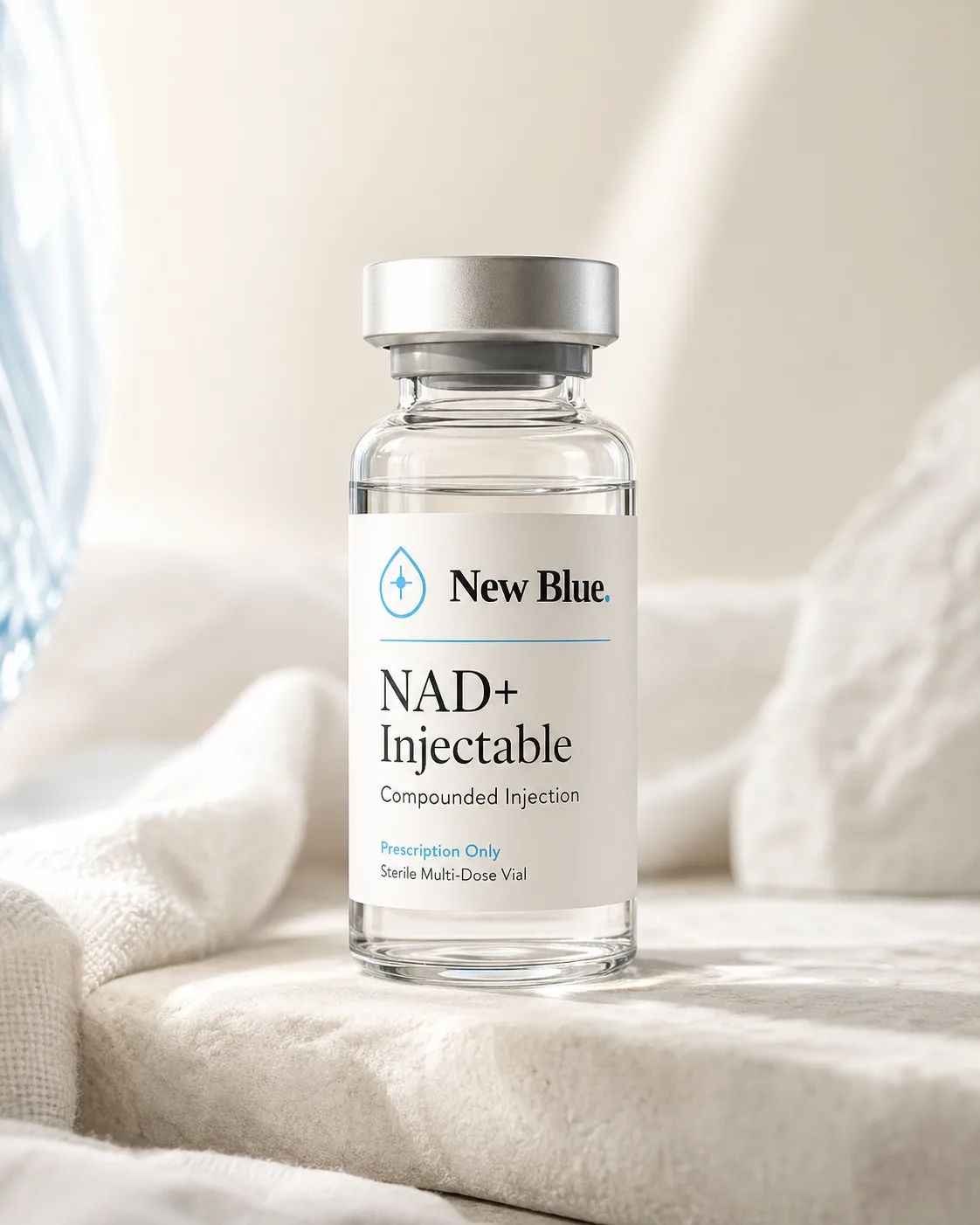
If you've been researching NAD+ supplementation, you've probably run into two dominant delivery methods — subcutaneous injections and intravenous (IV) drip therapy — and a lot of conflicting information about which one is "better." The confusion is understandable: most content online either comes from IV clinics with a financial incentive to push drip sessions, or from supplement brands selling oral capsules that sidestep the delivery question entirely. This article breaks down the actual differences between NAD+ injections and IV therapy across absorption, convenience, cost, and practical lifestyle fit, drawing on published research and the specific experience of New Blue Health, a LegitScript-certified telehealth platform that facilitates NAD+ pathways in 48 states (Alabama and Mississippi excluded).
What Is NAD+ and Why Does Delivery Method Matter?
Nicotinamide adenine dinucleotide (NAD+) is a coenzyme present in every living cell, essential for mitochondrial energy production, DNA repair, and sirtuin activation. Delivery method matters because NAD+ has poor oral bioavailability — the molecule is large, charged, and largely degraded in the gut before reaching systemic circulation.
That last point is critical. A 2020 study by Airhart et al. demonstrated that oral nicotinamide riboside (an NAD+ precursor) does raise whole-blood NAD+ levels, but the magnitude and speed of increase differ substantially from direct parenteral administration. When you bypass the gastrointestinal tract entirely — whether through an IV line or a subcutaneous injection — you eliminate first-pass metabolism and deliver the intact molecule (or its immediate precursors) directly into the bloodstream or interstitial tissue.
So the real question isn't oral vs. injectable. Most people who've done their homework already know oral NAD+ supplements have limitations. The real question is: which parenteral route makes more sense for your situation?
NAD+ IV Therapy: How It Works
IV NAD+ therapy delivers the compound directly into the bloodstream through a peripheral venous catheter, typically over a session lasting 2 to 4 hours. Some clinics run sessions as long as 6 hours for higher doses.
The appeal is straightforward: 100% of the administered dose enters systemic circulation immediately. There's no absorption curve, no depot effect, no waiting. For acute clinical scenarios — such as addiction detoxification protocols, where high-dose NAD+ infusions have been investigated — this rapid, complete bioavailability has clear utility.
But IV therapy comes with practical constraints that are easy to underestimate before your first session:
- Time commitment. Each infusion typically requires 2–4 hours in a chair, plus travel time to and from the clinic. For a protocol calling for multiple sessions per week, this can consume 10+ hours weekly.
- Clinical setting required. IV access must be established by a trained professional. You cannot self-administer an IV drip at home in most jurisdictions without oversight.
- Side effects during infusion. Rapid NAD+ infusion can cause chest tightness, nausea, flushing, and cramping. Clinics often slow the drip rate to manage these symptoms, which extends session time further.
- Infection and infiltration risk. Any time a needle enters a vein, there's a non-zero risk of phlebitis, infiltration (where fluid leaks into surrounding tissue), or infection at the insertion site.
None of these are reasons to dismiss IV therapy outright. They're trade-offs — and whether they matter depends on your schedule, your proximity to a qualified clinic, and your tolerance for sitting in a recliner with a line in your arm.
NAD+ Injections (Subcutaneous): How They Work
Subcutaneous NAD+ injections deliver the compound into the fatty tissue layer just beneath the skin, typically in the abdomen or thigh. The injection itself takes under a minute. After a brief training — usually provided via instructional materials included with the prescription — most people self-administer at home without difficulty.
The mechanism differs from IV in one important respect: rather than entering the bloodstream all at once, the NAD+ forms a small depot in subcutaneous tissue and absorbs gradually over a period of hours. Think of it as a slow-release profile versus the IV's bolus delivery.
This slower absorption has a practical upside that rarely gets discussed: it tends to produce fewer of the acute side effects (nausea, flushing, chest pressure) associated with rapid IV infusion. Brenner and colleagues noted in a 2019 review that the speed of NAD+ delivery appears to correlate with the intensity of vasomotor side effects, though controlled head-to-head comparisons between subcutaneous and IV routes remain limited.
For the NAD+ injectable pathway facilitated through New Blue Health, the medication is compounded at state-licensed 503A pharmacies and shipped directly to the patient's door — along with supplies — after a licensed clinician determines it's appropriate based on clinical review.
Absorption and Bioavailability: What the Research Suggests
Bioavailability is the percentage of an administered dose that reaches systemic circulation in active form. Here's how the two methods compare based on available evidence:
| Factor | IV Therapy | Subcutaneous Injection | |---|---|---| | Bioavailability | ~100% (direct venous access) | Estimated 80–95% (varies by formulation and injection site) | | Onset of peak levels | Minutes | 1–3 hours | | Duration of elevated levels | Shorter peak, faster clearance | More sustained, gradual curve | | First-pass metabolism | Bypassed entirely | Bypassed entirely | | Absorption variability | Minimal | Moderate (depends on tissue perfusion, injection technique) |
A few caveats. The subcutaneous bioavailability figures for NAD+ specifically are extrapolated from pharmacokinetic data on similarly sized molecules administered subcutaneously; large, dedicated PK studies comparing SC NAD+ to IV NAD+ in humans are still sparse. Grant and Bhatt (2021) published preliminary data suggesting subcutaneous NAD+ precursor administration achieved meaningful increases in whole-blood NAD+ within 2 hours, but the study was small (n=24) and used a specific formulation.
The honest answer: IV gives you faster, more complete delivery per session. Subcutaneous gives you a more sustained release with slightly lower peak bioavailability. Whether that 5–20% bioavailability difference matters clinically is an open question — and one that a licensed clinician should help you evaluate based on your specific health profile. For deeper context on the evidence behind NAD+ pathways, New Blue Health maintains a dedicated NAD+ evidence page that outlines the current research landscape.
Convenience and Lifestyle Considerations
This is where the two methods diverge most sharply — and where many people ultimately make their decision.
| Factor | IV Therapy | Subcutaneous Injection | |---|---|---| | Session time | 2–6 hours per session | Under 5 minutes | | Location | Clinic or medical office | Home (self-administered) | | Frequency (typical) | 1–4 sessions/week during loading, then monthly | Daily or several times per week (per clinician guidance) | | Travel required | Yes | No | | Professional supervision | Required each session | Initial training, then independent | | Scheduling flexibility | Limited to clinic hours | Any time |
For someone who lives near an IV clinic, has a flexible schedule, and prefers the reassurance of in-person medical supervision during each session, IV therapy can work well. But for men working full-time, traveling frequently, or living outside major metro areas, the math often doesn't add up. A 3-hour IV session plus 45 minutes of round-trip driving, repeated twice a week, represents a significant time investment.
Subcutaneous injections flip that equation. After the initial consultation and any necessary training, you're looking at a few minutes per day in your own bathroom. No appointments. No commute. No sitting in a clinic lobby.
One thing worth mentioning: New Blue Health also offers a NAD+ nasal spray option at $299, which provides yet another delivery route for people who prefer to avoid needles entirely. Nasal delivery has its own bioavailability characteristics — generally lower than injection but higher than oral — and whether it's appropriate depends on individual clinical review.
Cost Comparison: What to Expect
Cost is often the deciding factor, and the gap between IV therapy and subcutaneous injections is substantial.
| | IV NAD+ Therapy (Clinic) | Subcutaneous NAD+ (New Blue Health) | |---|---|---| | Per-session/per-month cost | $500–$1,500 per session (market average) | $249/30-day supply or $549/90-day supply | | Clinical consultation | Varies; often $100–$300 initial | Included (all-in price) | | Supplies included | Yes (in-clinic) | Yes (shipped with medication) | | Monthly cost for ongoing use | $2,000–$6,000+ (2–4 sessions/month) | $249–$275 all-in (clinical consultation included) | | Shipping | N/A | Included |
Those IV clinic numbers aren't inflated for effect. A quick survey of NAD+ IV clinics in major U.S. cities shows per-session pricing ranging from $400 on the low end (often for shorter, lower-dose sessions) to $1,500+ for premium protocols. Some clinics offer packages that bring the per-session cost down, but the total outlay remains dramatically higher than subcutaneous self-injection.
Through New Blue Health, the NAD+ injectable pathway starts at $249 for a 30-day supply — one honest all-in price that already includes the clinical review by an independent licensed clinician, with no separate consultation fee added on top, no membership fee, and no forced subscription. If a clinician determines treatment isn't appropriate, you're refunded your payment minus a $75 clinical consultation, which is non-refundable because the clinical review was still performed. For the 30-day NAD+ pathway ($249), that's a $174 refund. The 90-day supply at $549 brings the effective monthly cost down further.
To be clear: lower cost doesn't automatically mean "better value." If a licensed clinician determines that IV delivery is more appropriate for your clinical situation, the cost difference is secondary to the medical rationale. But for the majority of people exploring NAD+ for general cellular health support, the price gap is hard to ignore.
How Delivery Method Choice Works Through New Blue Health
New Blue Health is a technology and administrative services platform, not a medical provider. The process works like this: you choose a pathway (in this case, NAD+), complete a health intake, and a licensed clinician independently reviews your information. If the clinician determines that NAD+ therapy is appropriate for you, they select the delivery method and formulation based on your clinical profile. The compounded medication is then prepared at a state-licensed 503A pharmacy and shipped directly to you with all necessary supplies.
The platform currently facilitates NAD+ pathways in 48 states — Alabama and Mississippi are excluded. Andy Palenzuela, New Blue Health's founder, built the platform after 14+ years working in regulated health product supply chains, with a particular focus on ensuring that compounding pharmacy sourcing meets verifiable quality standards. You can read more about the platform's editorial and review standards and its compounding disclosure on the site.
Safety Considerations and When to Talk to a Clinician
Both IV and subcutaneous NAD+ carry risks that deserve honest discussion.
For IV therapy: vein irritation, bruising, infection at the catheter site, and the acute side effects mentioned earlier (nausea, flushing, chest tightness during infusion). These are generally manageable but can be uncomfortable, particularly during initial sessions.
For subcutaneous injections: injection site reactions (redness, mild swelling, occasional bruising), and the same systemic side effects as IV — though typically milder due to slower absorption.
For both routes: NAD+ can interact with certain medications and may not be appropriate for individuals with specific health conditions. This is precisely why clinical review matters. A licensed clinician evaluating your intake will consider your medical history, current medications, and health goals before determining whether NAD+ therapy — and which delivery method — is appropriate.
If you're unsure whether NAD+ is right for you, New Blue Health's safety policy outlines how clinical oversight is maintained throughout the process.
The Bottom Line — Which NAD+ Delivery Method Is Right for You?
Neither delivery method is universally superior. IV therapy offers faster, more complete per-session delivery but demands significant time, money, and access to a qualified clinic. Subcutaneous injections sacrifice a modest amount of peak bioavailability in exchange for dramatically greater convenience, lower cost, and the ability to self-administer at home on your own schedule.
For most men exploring NAD+ for cellular health and recovery support, subcutaneous injection represents the more practical long-term option. But "most" isn't "all" — and the right choice depends on your individual health profile, goals, and what a licensed clinician recommends after reviewing your specific situation.
Frequently Asked Questions
What is the regulatory status of compounded NAD+?
Compounded NAD+ is not a commercially manufactured pharmaceutical product. It is prepared at state-licensed 503A compounding pharmacies under applicable pharmacy regulations. The decision to prescribe compounded NAD+ is made by a licensed clinician based on individual clinical review.
Does New Blue Health prescribe NAD+ injections or IV therapy?
New Blue Health is a technology and administrative services platform, not a medical provider. Medical decisions — including whether to prescribe NAD+ and which delivery method is appropriate — are made by independent licensed clinicians. If appropriate, a licensed clinician may prescribe as part of the clinical review process.
How much do NAD+ pathways cost through New Blue Health?
NAD+ injectable pathways start at $249 for a 30-day supply and $549 for a 90-day supply, all-in (clinical consultation included). NAD+ nasal spray is $299. The price is all-in, with no separate consultation fee, no membership fee, and no forced subscription. If a clinician determines treatment isn't appropriate, you're refunded your payment minus a $75 clinical consultation (non-refundable because the clinical review was performed) — for the 30-day NAD+ pathway ($249), that's a $174 refund. Eligibility depends on clinical review. Visit the NAD+ pathway page for current details.
Is NAD+ therapy available in every state?
NAD+ pathways through New Blue Health are available in 48 states, subject to pathway, pharmacy, and provider availability. Alabama and Mississippi are not currently served. If you're unsure about availability in your state, contact support for clarification.
Which NAD+ delivery method is better — injections or IV?
Neither method is universally better. Each involves different trade-offs related to convenience, session time, cost, and absorption characteristics. The best delivery method depends on your individual health profile and goals, which should be discussed with a licensed clinician during clinical review.
Medical Disclaimer: This article is for informational purposes only and does not constitute medical advice, diagnosis, or treatment. All clinical decisions are made by independent licensed clinicians. New Blue Health is a technology and administrative services platform, not a medical provider. Individual results vary, and no specific outcomes are promised or implied. Consult a qualified healthcare professional before beginning any therapy.
Written by Andy Palenzuela — founder of New Blue Health, with 14+ years in regulated health product supply chains. Learn more about the clinical content team.
<!--SCHEMA_JSONLD [ { "@context": "https://schema.org", "@type": "Article", "headline": "NAD+ Injections vs IV Therapy: How Do the Two Delivery Methods Compare?", "description": "Explore the differences between NAD+ injections and IV therapy — including absorption, convenience, and cost. Discuss your options with a licensed clinician through New Blue Health. Pathways starting at $249, all-in (clinical consultation included).", "author": { "@type": "Person", "name": "Andy Palenzuela", "url": "[New Blue Health Clinical Content Team](/clinical-content-team)" }, "publisher": { "@type": "Organization", "name": "New Blue Health", "url": "https://newbluehealth.com" }, "datePublished": "2025-01-31", "dateModified": "2025-01-31", "mainEntityOfPage": { "@type": "WebPage", "@id": "[NAD+ Injections vs Iv Therapy](/blog/nad-injections-vs-iv-therapy)" } }, { "@context": "https://schema.org", "@type": "FAQPage", "mainEntity": [ { "@type": "Question", "name": "What is the regulatory status of compounded NAD+?", "acceptedAnswer": { "@type": "Answer", "text": "Compounded NAD+ is not a commercially manufactured pharmaceutical product. It is prepared at state-licensed 503A compounding pharmacies under applicable pharmacy regulations. The decision to prescribe compounded NAD+ is made by a licensed clinician based on individual clinical review." } }, { "@type": "Question", "name": "Does New Blue Health prescribe NAD+ injections or IV therapy?", "acceptedAnswer": { "@type": "Answer", "text": "New Blue Health is a technology and administrative services platform, not a medical provider. Medical decisions, including whether to prescribe NAD+ and which delivery method is appropriate, are made by independent licensed clinicians. If appropriate, a licensed clinician may prescribe as part of the clinical review process." } }, { "@type": "Question", "name": "How much do NAD+ pathways cost through New Blue Health?", "acceptedAnswer": { "@type": "Answer", "text": "NAD+ injectable pathways start at $249 for a 30-day supply and $549 for a 90-day supply, all-in (clinical consultation included). NAD+ nasal spray is $299. The price is all-in, with no separate consultation fee, no membership fee, and no forced subscription. If a clinician determines treatment isn't appropriate, you're refunded your payment minus a $75 clinical consultation (non-refundable because the clinical review was performed) — for the 30-day NAD+ pathway ($249), that's a $174 refund. Eligibility depends on clinical review." } }, { "@type": "Question", "name": "Is NAD+ therapy available in every state?", "acceptedAnswer": { "@type": "Answer", "text": "NAD+ pathways through New Blue Health are available in 48 states, subject to pathway, pharmacy, and provider availability. Alabama and Mississippi are not currently served. If you are unsure about availability in your state, contact support for clarification." } }, { "@type": "Question", "name": "Which NAD+ delivery method is better — injections or IV?", "acceptedAnswer": { "@type": "Answer", "text": "Neither method is universally better. Each involves different trade-offs related to convenience, session time, cost, and absorption characteristics. The best delivery method depends on your individual health profile and goals, which should be discussed with a licensed clinician during clinical review." } } ] }, { "@context": "https://schema.org", "@type": "MedicalWebPage", "about": { "@type": "MedicalTherapy", "name": "NAD+ Therapy" }, "headline": "NAD+ Injections vs IV Therapy: How Do the Two Delivery Methods Compare?", "lastReviewed": "2025-01-31", "url": "[NAD+ Injections vs Iv Therapy](/blog/nad-injections-vs-iv-therapy)" } ] -->Medical review & editorial standards
This page is educational content from the New Blue Health Clinical Content Team. It is reviewed under the New Blue Health Medical Review Policy and Editorial Policy and should not replace individualized medical advice from a licensed clinician. For how we evaluate evidence, see Evidence Methodology and Clinical Sources & References.