Medical Disclaimer: This article is for informational purposes only and does not constitute medical advice, diagnosis, or treatment. All medical decisions should be made in consultation with a qualified, licensed healthcare provider. New Blue Health is a technology and administrative services platform, not a medical provider. Medications discussed in this article are compounded at state-licensed 503A pharmacies pursuant to valid prescriptions from independent licensed clinicians. Individual results vary, and eligibility for any treatment depends on clinical review.
How to Tell a Legitimate Peptide Provider from a Research-Chemical Site
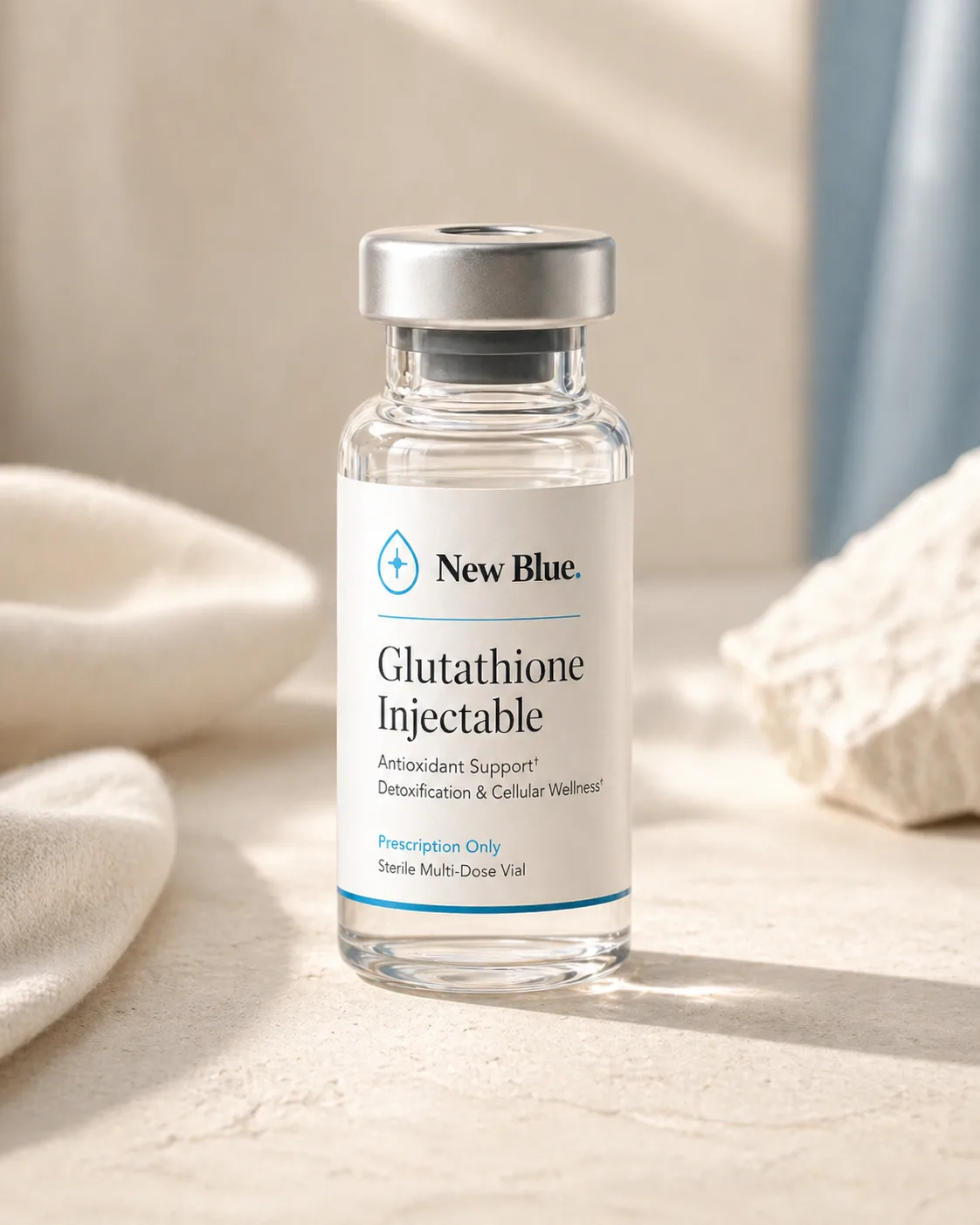
You want to try peptide therapy. Maybe it's sermorelin for recovery, maybe NAD+ for cellular support, maybe a GLP-1 agonist for metabolic health. You've done some reading. And now you're staring at two very different types of websites: one that looks like a clinical telehealth platform, and one that sells vials with disclaimers about "research use only." The difference between these two categories is not cosmetic — it's the difference between clinical oversight and self-experimentation with unverified substances.
The confusion is understandable. Peptide therapy exists in a gray area of public awareness. Mainstream medicine has studied many of these compounds extensively — Wilding et al. (2021) published landmark data on semaglutide for weight management in the New England Journal of Medicine, and Fahy et al. (2019) explored NAD+ precursors in the context of aging biology in Aging Cell. But the commercial landscape online mixes legitimate clinician-guided services with unregulated chemical vendors, and the visual difference between the two can be surprisingly small. This guide exists because the founder of New Blue Health, Andy Palenzuela, has spent 14+ years working in regulated health product supply chains and has seen firsthand how easily consumers get misled. Here's how to protect yourself.
Why This Distinction Matters — Health, Legal, and Safety Risks
Buying peptides from an unregulated source exposes you to three categories of risk: health risk from contaminated or mislabeled products, legal risk from purchasing prescription compounds without a valid prescription, and safety risk from self-dosing without clinical oversight.
Research-chemical sellers operate in a regulatory gap. They label products "for research purposes only" or "not for human consumption," which technically exempts them from pharmaceutical manufacturing standards. That means no third-party purity testing is required, no sterility assurance, and no accountability if the vial contains the wrong concentration — or the wrong compound entirely. A 2023 analysis by the Anti-Doping Sciences Institute at the University of Stirling found that nearly 40% of peptides purchased from online research-chemical vendors had significant discrepancies between labeled and actual content.
On the legal side, many peptides used therapeutically are prescription compounds. Purchasing them without a valid prescription from a licensed clinician isn't just risky — it may violate state and federal law. And from a pure safety standpoint, injecting yourself with a substance you bought from an anonymous website, at a dose you found on a forum, without any bloodwork or medical history review, is a gamble with your body.
Red Flag #1 — "Not for Human Consumption" Labels
If the product page says "for research use only" or "not for human consumption," you are not buying medication. You are buying an unregulated chemical.
This labeling is a legal shield for the seller, not a quality assurance marker. It means the product was not manufactured under the same standards required of compounding pharmacies. It was not prescribed by a clinician. And if something goes wrong — an infection at the injection site, an allergic reaction, a mislabeled concentration — you have essentially no recourse. The seller already told you not to use it on yourself.
Legitimate peptide therapy always begins with a prescription. That prescription comes from an independent licensed clinician who has reviewed your health information. The medication itself is compounded at a state-licensed 503A pharmacy, which must comply with USP <797> sterility standards and state board of pharmacy oversight. These are not optional quality upgrades. They are the baseline for any substance you plan to put in your body.
Red Flag #2 — No Prescriber Review, No Medical Intake, No Consultation
A legitimate peptide provider requires a clinical consultation before anything is prescribed. No exceptions.
If you can add a peptide to your cart and check out like you're buying a supplement, that's a research-chemical site — regardless of how professional the branding looks. Clinical oversight means an independent licensed clinician reviews your medical history, current medications, contraindications, and health goals before determining whether a specific compound is appropriate for you. This is especially critical for GLP-1 receptor agonists like semaglutide and tirzepatide, which carry contraindications including a history of medullary thyroid carcinoma (MTC), multiple endocrine neoplasia syndrome type 2 (MEN2), and a personal or family history of pancreatitis.
The consultation isn't a formality. It's the mechanism that separates therapy from self-experimentation. At New Blue Health, for example, the process works like this: you choose a treatment pathway, complete a detailed health intake, and an independent licensed clinician reviews your information. If — and only if — the clinician determines a prescription is appropriate, the medication is compounded and shipped from a state-licensed 503A pharmacy. The price is all-in — the $75 clinical consultation is included, not tacked on. If a clinician doesn’t prescribe, you’re refunded your payment minus the $75 clinical consultation, which signals that the clinical review is a real service, not a rubber stamp.
Red Flag #3 — No Verifiable Pharmacy, No LegitScript Certification, Offshore Sourcing
If the site doesn't name its pharmacy partner, doesn't hold third-party verification, or ships from an overseas address, proceed with extreme caution.
State-licensed 503A compounding pharmacies are subject to inspections, purity testing requirements, and regulatory oversight by their state board of pharmacy. When a telehealth platform sources medications from these pharmacies, there's a chain of accountability: the clinician writes the prescription, the pharmacy fills it under regulated conditions, and the patient receives a product with verifiable provenance.
Research-chemical sites rarely disclose where their products are manufactured. Some source from overseas labs with no U.S. regulatory oversight. Others operate domestically but outside the pharmacy licensing framework entirely.
One concrete way to verify a telehealth platform's legitimacy is to check for LegitScript certification. LegitScript is an independent verification service that evaluates telehealth platforms, pharmacies, and supplement companies against healthcare laws and industry standards. New Blue Health holds LegitScript certification — a detail you can verify independently on LegitScript's website. Not every legitimate platform has this certification, but its presence is a strong positive signal. Its absence, combined with other red flags, should give you pause.
For more detail on how to verify compounding sources, the Compounded Source Verification Checklist walks through the specific questions to ask.
Red Flag #4 — Opaque Pricing, Hidden Fees, or "Too Good to Be True" Costs
Transparent pricing means you can see exactly what you're paying for — one honest all-in price with no hidden add-ons — before you commit.
Research-chemical sites often advertise peptides at prices that seem dramatically lower than clinical telehealth platforms. A vial of "semaglutide" for $40 might look appealing next to a $299–$524 per 30-day supply from a clinician-guided service. But that comparison is misleading. The $40 vial doesn't include a clinical consultation, a prescription, sterility-assured compounding, supplies, or shipping. It also doesn't include any assurance that the vial actually contains what it claims to contain, at the concentration it claims to contain it.
Here's what transparent pricing looks like in practice:
| Cost Component | Research-Chemical Site | Legitimate Telehealth Platform | |---|---|---| | Clinical consultation | Not offered | Included in all-in price | | Prescriber review | None | Independent licensed clinician | | Medication | Unverified purity/concentration | Compounded at state-licensed 503A pharmacy | | Supplies (syringes, swabs) | Purchased separately, if at all | Included | | Shipping | Varies | Included |
At New Blue Health, pricing for treatment pathways is listed openly: semaglutide+B12 runs $299–$524 per 30-day supply, sermorelin is $279 per 28-day supply or $679 for 90 days, and NAD+ injectable starts at $249 per 30-day supply. Each pathway is one honest all-in price with the $75 clinical consultation included — no separate consultation fee, no membership fee, no forced subscription, no bundled mystery pricing. If a clinician doesn’t prescribe, you’re refunded your payment minus the $75 clinical consultation.
Red Flag #5 — Promises of Specific Outcomes, Dosing Instructions on Product Pages, or Outcome Claims
Any site that tells you exactly what dose to inject, promises a specific number of pounds lost, or claims a timeline for results is either unregulated or irresponsible — possibly both.
Dosing decisions belong to licensed clinicians, not product pages. A research-chemical site that lists "inject 0.25 mg subcutaneously weekly" is providing clinical guidance without a license, without knowing your medical history, and without any accountability. A legitimate telehealth platform will never publish dosing instructions on its website because dosing is individualized and determined by the prescribing clinician based on your specific health profile.
Similarly, be wary of outcome claims. Phrases like "lose 20 pounds in 8 weeks" or "reverse aging in 30 days" are not just misleading — they're a signal that the seller prioritizes conversion over safety. Individual results vary based on biology, adherence, lifestyle factors, and the clinical judgment of the prescribing clinician. No legitimate platform can or should promise specific outcomes.
Signs of a Legitimate Clinician-Guided Telehealth Provider
A trustworthy telehealth peptide platform will consistently demonstrate several characteristics. Here's a quick reference:
- Mandatory clinical intake before any prescription is issued
- Independent licensed clinicians making prescribing decisions — not the platform itself
- State-licensed 503A pharmacy sourcing with verifiable credentials
- Transparent, honest all-in pricing with no hidden add-ons
- Third-party verification such as LegitScript certification
- Clear geographic limitations — for instance, New Blue Health is available in 48 states (Alabama and Mississippi excluded), and states this openly on its state availability page
- No promises of specific outcomes and no implication that everyone qualifies
- Published editorial and review standards — see New Blue Health's medical review policy as an example
If a platform checks all of these boxes, you're likely dealing with a service that takes clinical oversight seriously.
What to Ask Before You Sign Up for Any Peptide Telehealth Service
Before you enter your credit card number, ask these questions. If the platform can't answer them clearly, walk away.
- Who reviews my health information? The answer should be "an independent licensed clinician" — not "our team" or "our algorithm."
- Where is the medication compounded? The answer should reference a specific state-licensed 503A pharmacy.
- Is the price all-in, or are there add-on fees (consultation, supplies, shipping, membership)? Hidden add-ons and surprise subscriptions can obscure what you’re really paying.
- What happens if the clinician determines I'm not a candidate? A legitimate platform will tell you that not everyone qualifies and that prescriptions are never guaranteed.
- Does the platform hold LegitScript certification or equivalent third-party verification?
For a deeper dive, the guide on questions to ask before starting peptide therapy covers additional considerations.
The Bottom Line — Protect Your Health by Choosing Oversight Over Convenience
Research-chemical sites are easy. Add to cart, check out, inject. No questions asked — literally. But "easy" is not the same as "safe," and the absence of friction is itself a warning sign. Clinical oversight exists for a reason: to protect you from contraindications you might not know about, from contaminated products, and from dosing errors that could cause real harm.
New Blue Health approaches this as a technology and administrative services platform, not a medical provider. The platform connects you with independent licensed clinicians who make prescribing decisions, and medications are compounded at state-licensed 503A pharmacies. The price is all-in — the $75 clinical consultation is included, not listed as a separate add-on. If a clinician doesn’t prescribe, you’re refunded your payment minus the $75 clinical consultation, because the clinical review is a genuine, independent medical evaluation — not a checkout formality.
Choosing a legitimate, clinician-guided pathway costs more than buying a research chemical. That's true. But the price difference pays for purity assurance, sterility standards, prescriber oversight, and legal protection. Those aren't luxuries. They're the minimum standard for anything you plan to put in your body.
Frequently Asked Questions
What is the difference between a research-chemical peptide seller and a legitimate telehealth peptide provider?
Research-chemical sellers offer peptides labeled "not for human consumption" with no prescriber review, no licensed pharmacy sourcing, and no clinical oversight. A legitimate clinician-guided telehealth provider connects you with an independent licensed clinician who reviews your health information and determines whether a prescription is appropriate. If prescribed, medications are compounded at state-licensed 503A pharmacies and shipped directly to you.
What is the regulatory status of compounded medications?
Compounded medications are not commercially manufactured products. They are prepared at state-licensed 503A compounding pharmacies pursuant to a valid prescription from a licensed clinician. This is an important distinction from both commercially manufactured brand-name drugs and unregulated research chemicals sold without prescriptions.
How do I know if a telehealth peptide provider is legitimate?
Look for these markers: the platform requires a clinical consultation before any prescription is issued, medications are sourced from state-licensed 503A pharmacies, pricing is transparent — one honest all-in price with no hidden add-ons, the platform holds third-party verification such as LegitScript certification, and the provider clearly states that not everyone qualifies — eligibility depends on clinical review.
Does everyone qualify for peptide therapy through a telehealth platform?
No. Eligibility depends on clinical review by an independent licensed clinician. A legitimate platform will never imply that everyone qualifies or that a prescription is guaranteed. The clinician independently evaluates your health information and determines whether a specific treatment is appropriate for you.
What should I expect to pay for a legitimate telehealth peptide consultation?
Legitimate telehealth platforms display pricing transparently. You should see one clear, all-in price with no surprise add-ons. At New Blue Health, the price is all-in — the clinical consultation is included, not tacked on. If a clinician doesn’t prescribe, you’re refunded your payment minus the $75 clinical consultation. Be cautious of platforms that hide costs behind surprise membership or subscription fees, or charge nothing for clinical review — that may indicate no real clinical oversight is occurring.
Medical Disclaimer: This article is for informational purposes only and does not constitute medical advice, diagnosis, or treatment. All medical decisions should be made in consultation with a qualified, licensed healthcare provider. New Blue Health is a technology and administrative services platform, not a medical provider. Compounded medications are prepared at state-licensed 503A pharmacies and are not commercially manufactured. Individual results vary, and eligibility for any treatment depends on independent clinical review. GLP-1 receptor agonists such as semaglutide and tirzepatide carry contraindications including personal or family history of medullary thyroid carcinoma (MTC), multiple endocrine neoplasia syndrome type 2 (MEN2), and pancreatitis. Discuss all contraindications with your prescribing clinician.
Written by Andy Palenzuela — founder of New Blue Health, with 14+ years in regulated health product supply chains. Clinical content reviewed in accordance with New Blue Health's clinical content standards.
<!--SCHEMA_JSONLD [ { "@context": "https://schema.org", "@type": "Article", "headline": "How to Tell a Legitimate Peptide Provider from a Research-Chemical Site: A Buyer's Guide", "description": "Learn how to distinguish a legitimate clinician-guided peptide provider from a research-chemical seller. Understand red flags, licensing requirements, and what transparent pricing (one honest all-in price, no hidden add-ons) looks like.", "author": { "@type": "Person", "name": "Andy Palenzuela" }, "publisher": { "@type": "Organization", "name": "New Blue Health", "url": "https://newbluehealth.com" }, "datePublished": "2025-01-31", "dateModified": "2025-01-31", "mainEntityOfPage": { "@type": "WebPage", "@id": "[Legitimate Peptide Provider vs Research Chemical Site](/blog/legitimate-peptide-provider-vs-research-chemical-site)" } }, { "@context": "https://schema.org", "@type": "FAQPage", "mainEntity": [ { "@type": "Question", "name": "What is the difference between a research-chemical peptide seller and a legitimate telehealth peptide provider?", "acceptedAnswer": { "@type": "Answer", "text": "Research-chemical sellers offer peptides labeled 'not for human consumption' with no prescriber review, no licensed pharmacy sourcing, and no clinical oversight. A legitimate clinician-guided telehealth provider connects you with an independent licensed clinician who reviews your health information and determines whether a prescription is appropriate. If prescribed, medications are compounded at state-licensed 503A pharmacies and shipped directly to you." } }, { "@type": "Question", "name": "What is the regulatory status of compounded medications?", "acceptedAnswer": { "@type": "Answer", "text": "Compounded medications are not commercially manufactured products. They are prepared at state-licensed 503A compounding pharmacies pursuant to a valid prescription from a licensed clinician. This is an important distinction from both commercially manufactured brand-name drugs and unregulated research chemicals sold without prescriptions." } }, { "@type": "Question", "name": "How do I know if a telehealth peptide provider is legitimate?", "acceptedAnswer": { "@type": "Answer", "text": "Look for these markers: the platform requires a clinical consultation before any prescription is issued, medications are sourced from state-licensed 503A pharmacies, pricing is transparent — one honest all-in price with no hidden add-ons, the platform holds third-party verification such as LegitScript certification, and the provider clearly states that not everyone qualifies — eligibility depends on clinical review." } }, { "@type": "Question", "name": "Does everyone qualify for peptide therapy through a telehealth platform?", "acceptedAnswer": { "@type": "Answer", "text": "No. Eligibility depends on clinical review by an independent licensed clinician. A legitimate platform will never imply that everyone qualifies or that a prescription is guaranteed. The clinician independently evaluates your health information and determines whether a specific treatment is appropriate for you." } }, { "@type": "Question", "name": "What should I expect to pay for a legitimate telehealth peptide consultation?", "acceptedAnswer": { "@type": "Answer", "text": "Legitimate telehealth platforms display pricing transparently. You should see one clear, all-in price with no surprise add-ons. At New Blue Health, the price is all-in — the clinical consultation is included, not tacked on. If a clinician doesn’t prescribe, you’re refunded your payment minus the $75 clinical consultation. Be cautious of platforms that hide costs behind surprise membership or subscription fees, or charge nothing for clinical review — that may indicate no real clinical oversight is occurring." } } ] }, { "@context": "https://schema.org", "@type": "MedicalWebPage", "about": { "@type": "MedicalCondition", "name": "Peptide therapy evaluation and provider selection" }, "headline": "How to Tell a Legitimate Peptide Provider from a Research-Chemical Site: A Buyer's Guide", "lastReviewed": "2025-01-31" } ] -->Medical review & editorial standards
This page is educational content from the New Blue Health Clinical Content Team. It is reviewed under the New Blue Health Medical Review Policy and Editorial Policy and should not replace individualized medical advice from a licensed clinician. For how we evaluate evidence, see Evidence Methodology and Clinical Sources & References.