Medical Disclaimer: This article is for informational purposes only and does not constitute medical advice, diagnosis, or treatment. All clinical decisions are made by licensed clinicians based on individual patient evaluation. Consult a qualified healthcare professional before starting any new treatment. New Blue Health is a technology and administrative services platform, not a medical provider.
GHK-Cu Cream Explained: What to Know About Topical Copper Peptides for Skin and Collagen Support
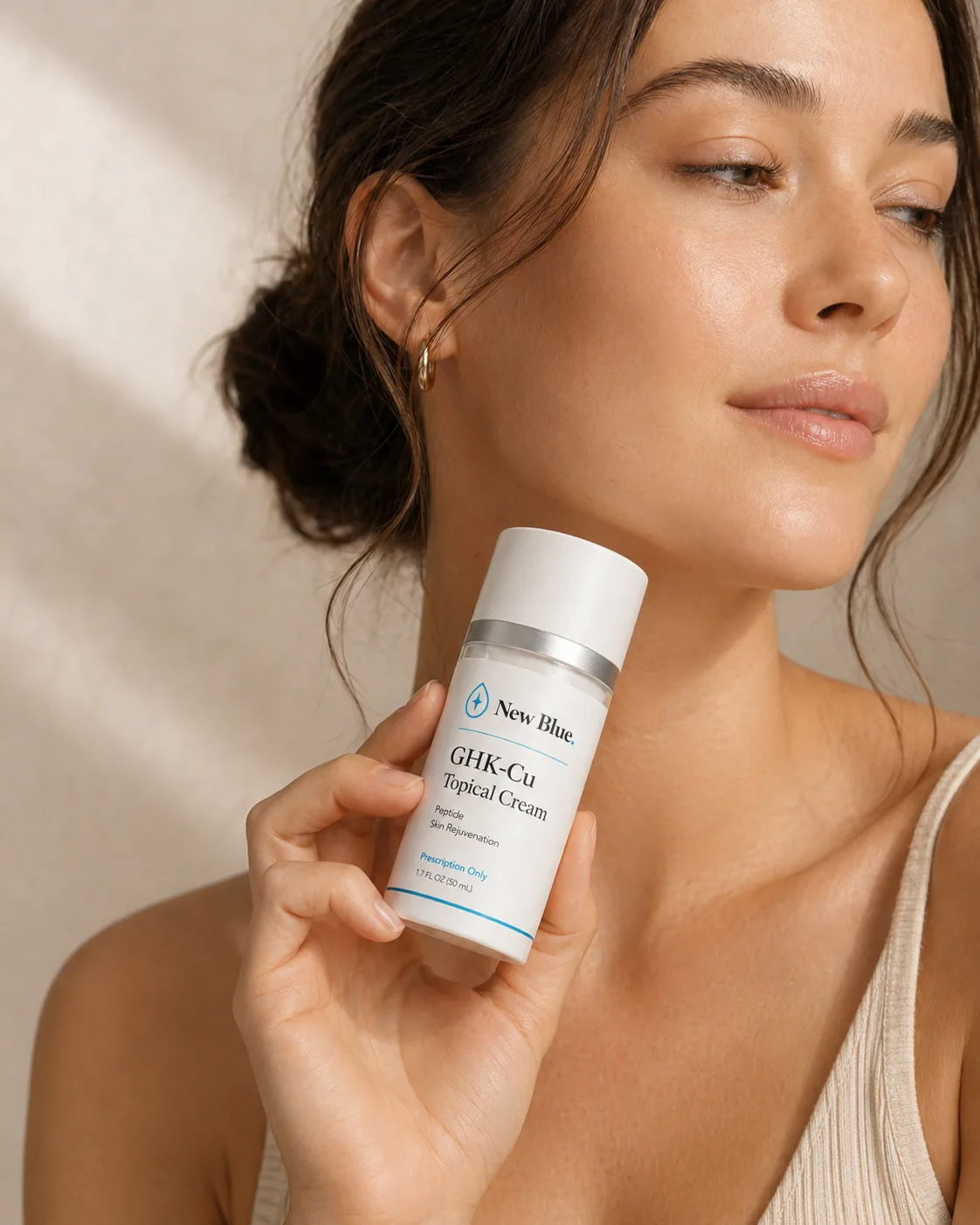
GHK-Cu is one of those peptides that has been sitting in the dermatology and wound-healing literature for decades, yet most people only encounter it through Instagram ads for copper peptide serums — products that range from rigorously formulated to essentially decorative. The gap between what published research actually says about GHK-Cu and what skincare marketing implies is wide enough to cause real confusion. This guide breaks down the science, the product landscape, and the practical differences between over-the-counter cosmetic formulations and prescription-strength compounded options — drawing on published data and the clinical framework used by licensed clinicians who work with platforms like New Blue Health.
What Is GHK-Cu? Understanding the Copper Peptide
GHK-Cu (glycyl-L-histidyl-L-lysine copper complex) is a naturally occurring tripeptide — three amino acids bound to a copper ion — found in human plasma, saliva, and urine. It was first isolated from human albumin by Pickart and Thaler in 1973, and its concentration in plasma declines measurably with age: roughly 200 ng/mL at age 20, dropping to around 80 ng/mL by age 60.
That decline matters because GHK-Cu appears to participate in several biological processes related to tissue maintenance. It is not a drug in the traditional sense. It is an endogenous molecule — something your body already produces — that has attracted research interest precisely because its levels correlate with age-related changes in skin, wound healing, and connective tissue integrity.
The copper ion is not incidental. Copper is a cofactor for lysyl oxidase, an enzyme critical to collagen and elastin cross-linking. Without adequate copper availability at the tissue level, the structural proteins that give skin its firmness and elasticity cannot be properly assembled. GHK-Cu essentially delivers copper in a biologically active, peptide-bound form that cells appear to recognize and utilize.
How GHK-Cu Works: Mechanism of Action in Skin
GHK-Cu influences skin biology through multiple pathways rather than a single receptor interaction. Published mechanistic work — particularly by Pickart et al. (2012, 2015) — identifies several key activities: stimulation of collagen synthesis (types I and III), upregulation of decorin (a proteoglycan involved in collagen fibril organization), increased production of glycosaminoglycans, and modulation of metalloproteinases (MMPs) that break down extracellular matrix components.
In simpler terms, GHK-Cu appears to both encourage the production of new structural proteins and slow the enzymatic degradation of existing ones. That dual action is why it shows up in both wound-healing and anti-aging research contexts.
There is also a signaling dimension. Pickart's gene expression studies (2014) using the Broad Institute's Connectivity Map found that GHK-Cu influenced the expression of 4,000+ human genes, with a pattern that broadly shifted gene activity toward a "younger" profile. That is a striking finding, though it comes from in vitro and computational work — not from topical application studies in humans. The distinction matters.
One mechanism that is better supported in applied research: GHK-Cu's role in attracting immune cells and fibroblasts to sites of tissue damage. This chemotactic activity is part of why it was originally studied in wound healing before the cosmetic industry adopted it.
What Does the Research Say? Published Studies on GHK-Cu and Skin
The research base for GHK-Cu is real but uneven. Animal and in vitro data are robust. Human clinical data on topical formulations specifically are more limited, though growing.
Abdulghani et al. (1998) conducted a controlled study comparing a GHK-Cu–containing cream to vitamin C cream and retinoic acid cream in human subjects. The GHK-Cu cream improved skin laxity and clarity, and reduced fine lines — performing comparably to the other active treatments in several measures. This remains one of the more frequently cited human studies.
Leyden et al. (2002) published data showing that a facial cream containing GHK-Cu improved skin density and thickness as measured by ultrasound, with statistically significant results over a 12-week period.
Preclinically, Maquart et al. (1988, 1999) demonstrated that GHK-Cu stimulated collagen synthesis in fibroblast cultures and accelerated wound contraction in animal models. These findings have been replicated across multiple labs.
What the literature does not yet provide is a large-scale, multi-center, placebo-controlled trial of topical GHK-Cu for cosmetic outcomes. That level of evidence typically requires pharmaceutical-industry funding, and since GHK-Cu is a naturally occurring peptide that cannot be patented in its base form, the economic incentive for such trials is limited. This is a common pattern with endogenous peptides — the biology is compelling, but the clinical trial infrastructure lags behind proprietary molecules.
For a deeper look at the evidence base, New Blue Health maintains a dedicated GHK-Cu evidence page with sourced references.
Topical GHK-Cu Cream: What It Is and How It's Used
Topical GHK-Cu cream is exactly what it sounds like: a cream formulation containing the GHK-Cu peptide complex designed for application to the skin. The idea is straightforward — deliver the peptide directly to the tissue where it acts, bypassing systemic circulation entirely.
Formulation matters enormously here. GHK-Cu is a relatively small peptide (molecular weight ~403 Da), which gives it a theoretical advantage in skin penetration compared to larger peptides. But the vehicle — the cream base, stabilizers, pH, and any penetration enhancers — determines how much active peptide actually reaches the dermal layer where fibroblasts reside.
This is where concentration becomes relevant. Over-the-counter products typically contain GHK-Cu at concentrations that are not disclosed or are quite low. Prescription-strength compounded GHK-Cu cream, by contrast, is prepared at specified concentrations. Through New Blue Health's GHK-Cu pathway, for example, compounded formulations are available at 0.2% ($229), 2% ($324), and 4% ($369) — a tenfold to twentyfold range in concentration that reflects meaningfully different levels of peptide delivery.
Application is typically once or twice daily to clean skin. But specific usage guidance is a clinical decision — something a licensed clinician determines based on individual factors, not something that should be standardized from a blog post.
OTC Copper Peptide Products vs. Prescription-Strength GHK-Cu
This is where most of the confusion lives, so a direct comparison is useful.
| Factor | OTC Copper Peptide Products | Prescription-Strength Compounded GHK-Cu Cream | |---|---|---| | Regulation | Regulated as cosmetics | Compounded at state-licensed 503A pharmacies per individual prescription | | Concentration | Varies widely; often undisclosed | Specified (e.g., 0.2%, 2%, 4%) | | Peptide Stability | Variable; depends on manufacturer | Compounded with pharmaceutical-grade stability controls | | Clinician Oversight | None required | Requires clinical review and prescription | | Price Range | $15–$80 typical | $229–$369 depending on concentration | | Quality Assurance | Manufacturer-dependent | Pharmacy-regulated under state board oversight |
Neither category is inherently "better." An OTC copper peptide serum from a reputable brand may be perfectly appropriate for someone exploring basic skincare support. But if concentration control, peptide purity, and clinician guidance matter to you — or if you want a formulation at concentrations not available in cosmetic products — then a compounded prescription option is a different category entirely.
One practical note: peptide stability in cosmetic formulations is a genuine concern. GHK-Cu can degrade when exposed to certain pH ranges, oxidation, or incompatible ingredients. Compounding pharmacies formulate specifically for stability. Many OTC products do not disclose stability testing data.
Who Researches GHK-Cu? The Audience Profile
The typical person searching for GHK-Cu cream information is not a casual skincare browser. Search data and platform intake patterns suggest a specific profile: adults (predominantly men 30–55) who have already tried conventional skincare approaches and are looking for something with a stronger mechanistic rationale. Many are already familiar with peptide-based therapies in other contexts — recovery, metabolic support, longevity — and are extending that framework to skin health.
This tracks with New Blue Health's intake data. Andy Palenzuela, the platform's founder with 14+ years in regulated health product supply chains, has noted that GHK-Cu inquiries disproportionately come from users already engaged with other peptide pathways on the platform — people who understand compounding, who read studies, and who are less interested in marketing claims than in mechanism-of-action explanations.
That audience profile shapes how this information should be presented: with specificity, without hype, and with honest acknowledgment of where the evidence is strong and where it has gaps.
GHK-Cu and Collagen: What the Science Supports
GHK-Cu's relationship to collagen is the most studied aspect of its biology. Maquart et al. (1988) showed that GHK-Cu stimulated collagen synthesis in cultured fibroblasts at concentrations as low as 10⁻⁹ M. Subsequent work demonstrated increased production of both type I and type III collagen, along with upregulation of tissue inhibitors of metalloproteinases (TIMPs), which slow collagen breakdown.
The collagen story has a second chapter: organization. Collagen production alone does not guarantee functional tissue. The collagen fibrils need to be properly cross-linked and organized. GHK-Cu's stimulation of decorin — a small leucine-rich proteoglycan — appears to support this organizational step. Decorin binds to collagen fibrils and regulates their diameter and spacing. Without adequate decorin, you get disorganized collagen — think scar tissue rather than healthy skin.
This dual role (production + organization) is part of why GHK-Cu was originally investigated in wound-healing contexts, where both processes are critical. The cosmetic application is essentially the same biology applied to age-related collagen loss rather than acute injury.
However — and this matters — most of this mechanistic data comes from cell culture and animal models. The human topical studies (Abdulghani, Leyden) measured clinical endpoints like skin thickness and fine lines rather than directly quantifying collagen synthesis in vivo. The mechanistic inference is reasonable but not directly proven in human skin from topical application alone.
Safety Considerations and What to Discuss With a Clinician
GHK-Cu has a favorable safety profile in published literature. It is an endogenous molecule, and topical application avoids systemic exposure concerns. Reported adverse effects in studies have been minimal — primarily mild local irritation in some subjects, which is common with any active topical.
That said, a few considerations are worth discussing with a clinician before starting any prescription-strength formulation:
- Copper sensitivity: Individuals with Wilson's disease or other copper metabolism disorders should not use copper-containing products without medical guidance.
- Concurrent topical actives: GHK-Cu's interaction with retinoids, acids, or other active ingredients has not been extensively studied. A clinician can advise on sequencing and compatibility.
- Concentration selection: Higher concentration does not automatically mean better results. The appropriate strength depends on skin type, treatment goals, and individual tolerance — a clinical determination, not a consumer choice.
New Blue Health's process requires completion of a health intake form that a licensed clinician reviews before any prescription is written. The price is all-in and already includes the $75 clinical consultation that covers this review — it is not added on top. If a clinician doesn’t prescribe, you’re refunded your payment minus the $75 clinical consultation (a $154 refund on the $229 pathway), because the clinical review was performed. Prescriptions are written only if clinically appropriate — eligibility is never assumed. This framework is consistent with the platform's LegitScript certification and its safety policy.
How New Blue Health Supports Your Exploration
New Blue Health is a technology and administrative services platform, not a medical provider. It connects individuals with licensed clinicians who independently evaluate whether a given treatment pathway — including compounded GHK-Cu cream — is appropriate based on clinical review. If prescribed, medications are compounded and shipped directly by state-licensed 503A pharmacies. The platform is available in 48 states (Alabama and Mississippi excluded). All content published by the platform is reviewed according to its editorial policy.
Key Takeaways: Is GHK-Cu Cream Worth Exploring?
GHK-Cu is not a miracle ingredient, and anyone describing it that way is selling something. What it is: a well-characterized endogenous peptide with decades of mechanistic research, a handful of supportive human studies, and a plausible biological rationale for skin and collagen support. The gap between OTC cosmetic products and prescription-strength compounded formulations is real and measurable — in concentration, stability, and clinical oversight. Whether that gap matters to you depends on your goals, your budget, and your willingness to engage with a clinician-guided process rather than a retail one.
Frequently Asked Questions
What is GHK-Cu cream used for?
GHK-Cu cream is a topical formulation containing the copper peptide GHK-Cu. It has been researched for its potential role in supporting skin health, collagen metabolism, and skin remodeling processes. It is available in both over-the-counter cosmetic formulations and prescription-strength compounded versions. Anyone considering a prescription-strength option should discuss it with a licensed clinician.
What is the regulatory status of compounded GHK-Cu cream?
Over-the-counter GHK-Cu products are regulated as cosmetics, not drugs. Prescription-strength GHK-Cu formulations are compounded at state-licensed 503A pharmacies per individual prescriptions — compounded medications are prepared to order, not commercially manufactured. This is standard for compounded preparations and does not mean they are unsafe, but it is an important distinction to understand.
What is the difference between OTC copper peptide serums and prescription GHK-Cu cream?
OTC copper peptide products are widely available and regulated as cosmetics. They vary significantly in concentration, formulation quality, and peptide stability. Prescription-strength GHK-Cu cream is compounded at state-licensed 503A pharmacies based on a clinician's prescription and may contain higher or more precisely controlled concentrations. Eligibility for prescription formulations depends on clinical review.
Can I get GHK-Cu cream through New Blue Health?
New Blue Health is a technology and administrative services platform, not a medical provider or pharmacy. It facilitates access to clinician-guided metabolic and longevity care. If appropriate after clinical review, a licensed clinician may prescribe compounded GHK-Cu cream, which would be prepared and shipped directly by a state-licensed 503A pharmacy. The price is all-in and already includes the $75 clinical consultation — there is no separate consultation fee. If a clinician doesn’t prescribe, you’re refunded your payment minus the $75 clinical consultation (a $154 refund on the $229 pathway). Service is available in 48 states (Alabama and Mississippi excluded).
Does GHK-Cu cream really work for collagen and skin health?
Published research — including both preclinical studies and some human studies — suggests that GHK-Cu may support collagen synthesis and skin remodeling processes. However, results vary by individual, and the body of human clinical data on topical GHK-Cu specifically continues to grow. No specific outcomes can be promised. Review published research and discuss options with a licensed clinician.
Medical Disclaimer: This article is for informational purposes only and does not constitute medical advice, diagnosis, or treatment. All clinical decisions are made by licensed clinicians based on individual patient evaluation. New Blue Health is a technology and administrative services platform, not a medical provider. Consult a qualified healthcare professional before beginning any treatment.
Written by Andy Palenzuela — founder of New Blue Health, with 14+ years in regulated health product supply chains. Content reviewed by the New Blue Health Clinical Content Team.
<!--SCHEMA_JSONLD [ { "@context": "https://schema.org", "@type": "Article", "headline": "GHK-Cu Cream Explained: What to Know About Topical Copper Peptides for Skin and Collagen Support", "description": "Learn what GHK-Cu cream is, how topical copper peptides may support skin and collagen health, and the difference between OTC and prescription options. Explore clinician-guided pathways at New Blue Health — posted all-in pricing (clinical consultation included).", "author": { "@type": "Person", "name": "Andy Palenzuela", "url": "[About New Blue Health](/about)" }, "publisher": { "@type": "Organization", "name": "New Blue Health", "url": "https://newbluehealth.com" }, "datePublished": "2025-01-31", "dateModified": "2025-01-31", "mainEntityOfPage": { "@type": "WebPage", "@id": "https://newbluehealth.com/ghk-cu-cream-topical-copper-peptide-guide" } }, { "@context": "https://schema.org", "@type": "FAQPage", "mainEntity": [ { "@type": "Question", "name": "What is GHK-Cu cream used for?", "acceptedAnswer": { "@type": "Answer", "text": "GHK-Cu cream is a topical formulation containing the copper peptide GHK-Cu. It has been researched for its potential role in supporting skin health, collagen metabolism, and skin remodeling processes. It is available in both over-the-counter cosmetic formulations and prescription-strength compounded versions. Anyone considering a prescription-strength option should discuss it with a licensed clinician." } }, { "@type": "Question", "name": "What is the regulatory status of compounded GHK-Cu cream?", "acceptedAnswer": { "@type": "Answer", "text": "Over-the-counter GHK-Cu products are regulated as cosmetics, not drugs. Prescription-strength GHK-Cu formulations are compounded at state-licensed 503A pharmacies per individual prescriptions — compounded medications are prepared to order, not commercially manufactured. This is standard for compounded preparations and does not mean they are unsafe, but it is an important distinction to understand." } }, { "@type": "Question", "name": "What is the difference between OTC copper peptide serums and prescription GHK-Cu cream?", "acceptedAnswer": { "@type": "Answer", "text": "OTC copper peptide products are widely available and regulated as cosmetics. They vary significantly in concentration, formulation quality, and peptide stability. Prescription-strength GHK-Cu cream is compounded at state-licensed 503A pharmacies based on a clinician's prescription and may contain higher or more precisely controlled concentrations. Eligibility for prescription formulations depends on clinical review." } }, { "@type": "Question", "name": "Can I get GHK-Cu cream through New Blue Health?", "acceptedAnswer": { "@type": "Answer", "text": "New Blue Health is a technology and administrative services platform, not a medical provider or pharmacy. It facilitates access to clinician-guided metabolic and longevity care. If appropriate after clinical review, a licensed clinician may prescribe compounded GHK-Cu cream, which would be prepared and shipped directly by a state-licensed 503A pharmacy. The price is all-in and already includes the $75 clinical consultation — there is no separate consultation fee. If a clinician doesn’t prescribe, you’re refunded your payment minus the $75 clinical consultation (a $154 refund on the $229 pathway). Service is available in 48 states (Alabama and Mississippi excluded)." } }, { "@type": "Question", "name": "Does GHK-Cu cream really work for collagen and skin health?", "acceptedAnswer": { "@type": "Answer", "text": "Published research — including both preclinical studies and some human studies — suggests that GHK-Cu may support collagen synthesis and skin remodeling processes. However, results vary by individual, and the body of human clinical data on topical GHK-Cu specifically continues to grow. No specific outcomes can be promised. Review published research and discuss options with a licensed clinician." } } ] }, { "@context": "https://schema.org", "@type": "MedicalWebPage", "about": { "@type": "MedicalCondition", "name": "Skin aging and collagen loss" }, "lastReviewed": "2025-01-31", "mainContentOfPage": { "@type": "WebPageElement", "cssSelector": "article" } } ] -->Medical review & editorial standards
This page is educational content from the New Blue Health Clinical Content Team. It is reviewed under the New Blue Health Medical Review Policy and Editorial Policy and should not replace individualized medical advice from a licensed clinician. For how we evaluate evidence, see Evidence Methodology and Clinical Sources & References.