Medical Disclaimer: This article is for informational purposes only and does not constitute medical advice, diagnosis, or treatment. All medical decisions should be made in consultation with a licensed clinician. Tesamorelin is a prescription medication and is not appropriate for everyone. Individual results vary. New Blue Health is a technology and administrative services platform, not a medical provider.
Tesamorelin for Adults: What to Know About Visceral Fat and Growth Hormone Support
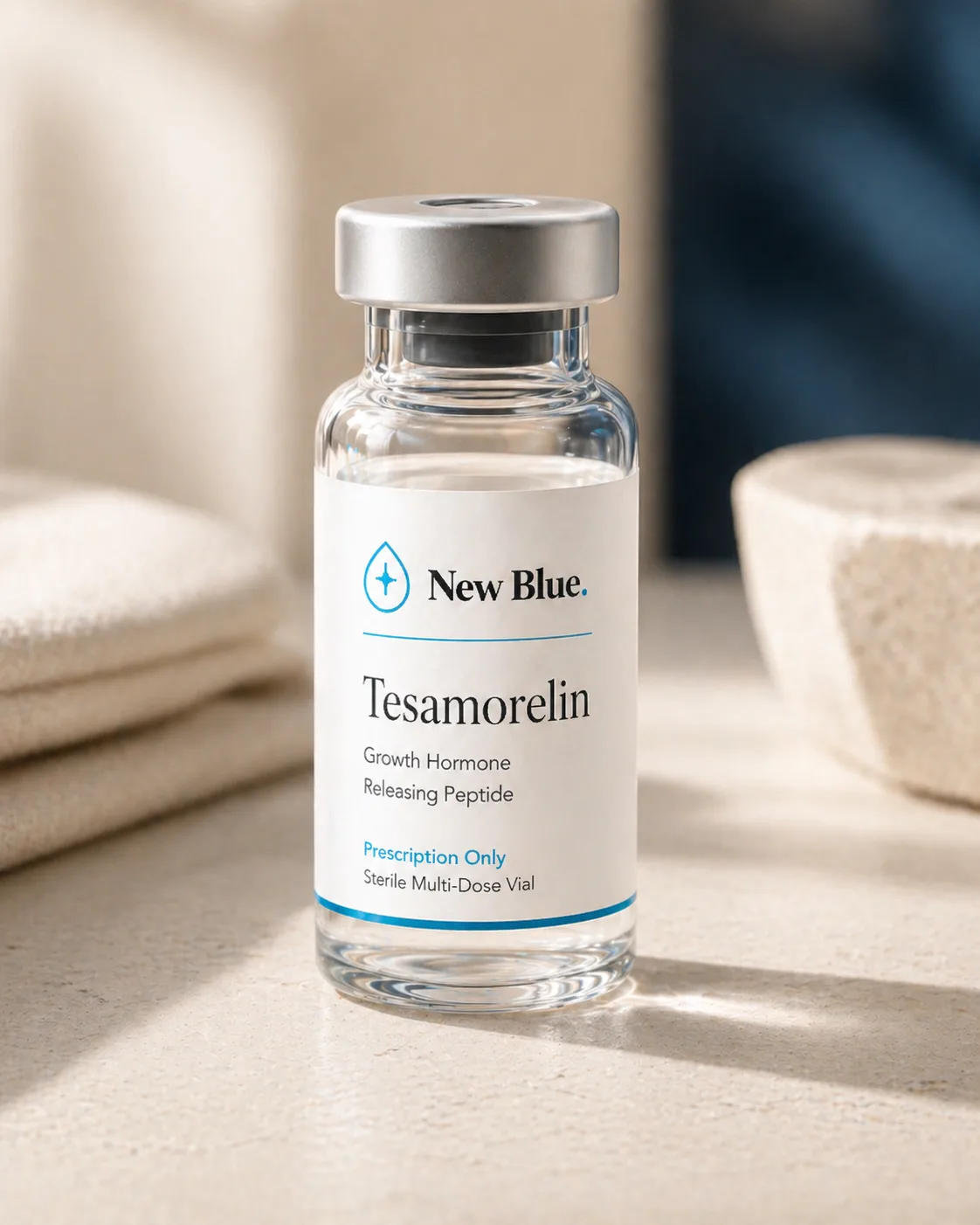
If you're a man between 30 and 55 researching tesamorelin for visceral fat, you've probably encountered a confusing mix of bodybuilding forums, gray-market peptide sites, and vague blog posts that promise everything and cite nothing. Sorting through that noise takes time you shouldn't have to spend. This article draws on published clinical research and the operational experience behind New Blue Health, a LegitScript-certified telehealth platform that has coordinated peptide pathways for adults. New Blue Health was founded by Andy Palenzuela, who brings 14-plus years in regulated health product supply chains. Availability varies by state; see our state availability page.
What Is Tesamorelin?
Tesamorelin is a synthetic analog of growth-hormone-releasing hormone (GHRH), a 44-amino-acid peptide naturally produced in the hypothalamus. It works by binding to GHRH receptors on the anterior pituitary gland, stimulating the pulsatile release of endogenous growth hormone (GH). Unlike exogenous GH injections, tesamorelin prompts your own pituitary to do the work, which preserves the body's natural feedback loops more closely than direct GH administration.
The brand-name version, Egrifta, was originally studied for and indicated in a specific clinical population: adults with HIV-associated lipodystrophy who accumulate excess visceral adipose tissue (VAT) as a side effect of antiretroviral therapy. That narrow indication doesn't capture the broader interest clinicians and patients now have in tesamorelin's mechanism. Compounded tesamorelin, prepared by state-licensed 503A compounding pharmacies or FDA-registered 503B outsourcing facilities, is the form most commonly accessed through telehealth pathways. It is not commercially manufactured and is dispensed only with an individual prescription. For a deeper look at the evidence base, New Blue Health maintains a dedicated tesamorelin evidence page with sourced citations.
Understanding Visceral Fat: Why It Matters for Men 30–55
Visceral adipose tissue (VAT) is the fat stored deep within the abdominal cavity, surrounding the liver, pancreas, and intestines. It is metabolically distinct from subcutaneous fat—the kind you can pinch. VAT is biologically active, secreting inflammatory cytokines like interleukin-6 (IL-6) and tumor necrosis factor-alpha (TNF-α), which contribute to insulin resistance, dyslipidemia, and cardiovascular risk.
Here's why this matters for men in their 30s through mid-50s specifically. Growth hormone output declines roughly 14% per decade after age 30, according to data reviewed by Iranmanesh et al. (1991). As GH drops, visceral fat tends to accumulate even in men who maintain relatively stable body weight. You might weigh the same at 42 as you did at 32, but your body composition—particularly the ratio of visceral to subcutaneous fat—can shift substantially. Waist circumference increases. Metabolic markers drift. The frustrating part: visceral fat is notoriously resistant to diet and exercise alone, especially once the hormonal environment has changed.
That doesn't mean lifestyle interventions are useless. Resistance training and caloric management remain foundational. But some men reach a point where those tools alone aren't moving the needle on deep abdominal fat, and that's where clinical interest in GHRH analogs like tesamorelin enters the conversation.
How Tesamorelin May Support Visceral Fat Reduction
Tesamorelin's primary mechanism for addressing visceral fat is indirect: by restoring more youthful GH pulsatility, it increases lipolysis (fat breakdown) preferentially in visceral adipose depots. This preferential effect on VAT—rather than subcutaneous fat—has been one of the more consistent findings in the clinical literature.
Falutz et al. (2007) published a pivotal 26-week randomized, double-blind, placebo-controlled trial in 412 HIV-positive patients with excess abdominal fat. Participants receiving tesamorelin experienced a mean reduction of approximately 15% in trunk fat (measured by CT scan), compared to a 5% increase in the placebo group. A follow-up study by the same group (Falutz et al., 2010) confirmed durability of these effects over 52 weeks of treatment, though VAT tended to reaccumulate after discontinuation.
Two important caveats. First, these studies were conducted in a specific population (HIV-associated lipodystrophy), so extrapolating results to the general adult male population requires caution. Second, individual responses vary considerably. A licensed clinician evaluating your health history, lab work, and goals is the only person qualified to determine whether tesamorelin may be appropriate for you. No article—this one included—can substitute for that clinical judgment.
Tesamorelin and Growth Hormone: What the Research Shows
Beyond visceral fat, researchers have investigated tesamorelin's effects on GH and IGF-1 levels, body composition, and even cognitive markers. A 20-week randomized controlled trial in older adults (average age 66) found that tesamorelin increased GH secretion and improved certain measures of cognition, though the study was small and the cognitive findings are considered preliminary.
On the metabolic side, a randomized trial examined tesamorelin's effects on hepatic fat in HIV-positive adults with nonalcoholic fatty liver disease (NAFLD) and reported significant reductions in liver fat fraction measured by MRI, alongside improvements in fibrosis biomarkers. Again, this was a specific clinical population, but the mechanistic pathway—GH-mediated lipolysis reducing ectopic fat deposition—is relevant to understanding how tesamorelin interacts with metabolic health more broadly.
What tesamorelin does not do: it does not directly suppress appetite, alter thyroid function, or act as an anabolic steroid. Its effects are mediated through the GH axis, which influences fat metabolism, lean body mass maintenance, and cellular repair processes. The magnitude of these effects depends on the individual's baseline GH status, age, body composition, and adherence.
Who May Be Interested in Exploring Tesamorelin
Not everyone is a candidate. Tesamorelin is a prescription medication, and eligibility depends entirely on clinical review by an independent licensed clinician. That said, the profile of adults who typically express interest tends to include:
- Men aged 30–55 who have noticed increased abdominal circumference despite consistent exercise and nutrition habits
- Adults whose lab work shows declining IGF-1 levels or other markers suggestive of reduced GH output
- Individuals who have already addressed foundational factors (sleep, stress, diet, training) and are looking for additional clinical support
- People who want a GHRH-based approach rather than direct exogenous GH
Tesamorelin is not appropriate for individuals with active malignancy, hypersensitivity to tesamorelin or mannitol, or those who are pregnant. A clinician will evaluate contraindications during the consultation process.
Tesamorelin vs. Other Peptides: How It Compares
One of the most common questions is how tesamorelin stacks up against sermorelin, another GHRH analog available through telehealth pathways. New Blue Health publishes a detailed tesamorelin vs. sermorelin comparison for readers who want the full breakdown, but here's a summary:
| Feature | Tesamorelin | Sermorelin |
|---|---|---|
| Peptide type | GHRH analog (44 amino acids) | GHRH analog (29 amino acids, truncated) |
| Primary research focus | Visceral fat reduction, GH restoration | GH restoration, sleep quality, recovery |
| Published RCTs on visceral fat | Yes (Falutz et al., 2007 and 2010 in HIV-associated lipodystrophy) | Limited direct VAT data |
| 1-month path (New Blue Health, all-in) | $299 | $299 |
| Longer path (New Blue Health, all-in) | $498 (2-month path) | $597 (3-month path) |
| Route | Injectable | Injectable |
Both peptides work through the GHRH receptor. Tesamorelin has a stronger evidence base specifically for visceral fat reduction, while sermorelin is often explored for broader recovery and sleep-related goals. A licensed clinician can help determine which pathway—if either—is appropriate based on your clinical profile. For more on sermorelin specifically, see the sermorelin clinical review guide.
How Telehealth Coordinates Clinician-Guided Peptide Care
Telehealth has made it possible to access licensed clinician evaluations without sitting in a waiting room, but not all platforms operate the same way. Some sell peptides as "research chemicals" with no prescription, no clinician oversight, and no pharmacy licensure. That's a different category entirely—and a risky one. (New Blue Health's guide on evaluating peptide providers covers the red flags in detail.)
New Blue Health operates as a technology and administrative services platform, not a medical provider. The process works like this: you choose a treatment pathway, complete a medical intake form, and an independent licensed clinician reviews your information. If the clinician determines tesamorelin is appropriate, a prescription is issued and a licensed partner pharmacy prepares the medication and ships it directly to you. The platform coordinates logistics—intake, pharmacy communication, shipping—while clinical decisions remain entirely with the licensed clinician.
One detail worth noting: New Blue Health is LegitScript-certified, which means the platform has undergone third-party verification of its business practices, pharmacy relationships, and compliance standards. That certification is not universal among telehealth peptide platforms.
What to Expect: Pricing and the Consultation Process
Transparency on cost matters, so here are the actual numbers. Through New Blue Health, tesamorelin is available at one honest all-in price: $299 for the 1-month path or $498 for the 2-month path, with the clinical consultation included. There's no separate consultation fee, no membership fee, no forced subscription. If a clinician determines treatment isn't appropriate, the medication cost is refunded; the consultation terms are set out in the refund policy. All orders include the telehealth consultation, prescription (if prescribed), compounded medication, supplies, and shipping.
The consultation is not a rubber stamp. Not everyone qualifies. A clinician reviews your health history, current medications, and goals before making a prescribing decision. If tesamorelin isn't appropriate for you, the clinician may suggest an alternative pathway or recommend you follow up with your primary care physician.
Potential Side Effects and Safety Considerations
Like any prescription medication, tesamorelin carries potential side effects. Commonly reported effects in clinical trials include injection-site reactions (redness, itching, swelling), joint pain, and peripheral edema. Some participants in the Falutz et al. trials reported transient paresthesia (tingling or numbness).
Because tesamorelin increases GH secretion, it can raise IGF-1 levels. Elevated IGF-1 is a concern in individuals with active or suspected malignancy, which is why a cancer history is a contraindication. Fluid retention and carpal tunnel-like symptoms have also been reported, though these tend to be dose-dependent and reversible.
Anyone considering tesamorelin should discuss their full medical history—including any history of malignancy, pituitary conditions, or hypersensitivity—with a licensed clinician before starting treatment. New Blue Health's safety policy outlines the platform's approach to adverse event reporting and clinical oversight.
Key Takeaways and Next Steps
Tesamorelin is a GHRH analog with a published evidence base supporting its role in visceral fat reduction and GH restoration, primarily studied in HIV-associated lipodystrophy populations. Its mechanism—stimulating endogenous GH release rather than replacing it directly—makes it a distinct option within the peptide category. Compounded tesamorelin is prepared by state-licensed 503A compounding pharmacies or FDA-registered 503B outsourcing facilities and is available through clinician-guided telehealth pathways. Tesamorelin ships to every state New Blue Health serves except California; see our state availability page for current availability.
If you're considering tesamorelin, start by reviewing the evidence summary and the questions to ask before starting peptide therapy. Then complete an intake through New Blue Health to have a licensed clinician evaluate whether this pathway is appropriate for your situation.
Who May Be a Candidate for Tesamorelin? Eligibility and Clinical Review
Candidacy for compounded tesamorelin depends entirely on clinical review by a licensed clinician. There is no guaranteed eligibility. Factors a clinician may consider include:
- Age, sex, and overall health status
- Body composition and visceral fat distribution
- Existing medical conditions, particularly active malignancies (tesamorelin stimulates GH, which can promote cell proliferation)
- Current medications and potential interactions
- Lab work, including baseline IGF-1 levels
- History of pituitary disorders or hypothalamic dysfunction
Tesamorelin is not appropriate for everyone. Individuals with active malignancy, disruption of the hypothalamic-pituitary axis (such as from surgery, radiation, or head trauma), or hypersensitivity to tesamorelin or mannitol should not use it. Pregnant individuals should not use tesamorelin.
The clinical review process exists precisely because peptide therapy requires individualized assessment. Any platform that skips this step or implies that everyone qualifies should raise serious concerns. New Blue Health's guide on evaluating peptide providers covers what to look for—and what to avoid.
What to Expect: The Telehealth Process from Intake to Delivery
The process through New Blue Health follows a structured sequence:
- Choose a pathway. For tesamorelin, this falls under the Recovery/Performance category.
- Complete intake. You'll provide health history, current medications, and relevant medical information through a secure online form.
- Clinical review. A licensed clinician evaluates your intake. This is a real clinical assessment, not a rubber stamp. If appropriate, the clinician may prescribe.
- Pharmacy fulfillment. If prescribed, a licensed partner pharmacy prepares and ships the medication directly to you. Supplies and shipping are included.
Turnaround times vary depending on clinician availability and pharmacy processing. This is not an instant-gratification process, nor should it be.
Frequently Asked Questions
What is the regulatory status of compounded tesamorelin?
The brand-name version (Egrifta) was originally studied for and indicated in HIV-associated lipodystrophy. Compounded tesamorelin is not commercially manufactured—it is prepared by state-licensed 503A compounding pharmacies or FDA-registered 503B outsourcing facilities and dispensed only with an individual prescription. Eligibility depends on clinical review by a licensed clinician.
How does tesamorelin work for visceral fat?
Tesamorelin is a GHRH analog that stimulates the pituitary gland to release growth hormone. Published research, including the Falutz et al. (2007) trial, suggests this mechanism may support reductions in visceral adipose tissue, though individual results vary. Discuss your specific situation with a licensed clinician.
Does everyone qualify for tesamorelin through telehealth?
No. Eligibility depends on clinical review by an independent licensed clinician, and not everyone qualifies. A clinician will evaluate your health history, current medications, and goals to determine whether tesamorelin may be appropriate for you.
How much does a tesamorelin consultation cost?
The price is all-in and includes the clinical consultation ($299 for the 1-month path or $498 for the 2-month path) — no separate consultation fee, no membership fee, no forced subscription. If a clinician doesn't prescribe, the medication cost is refunded; the consultation terms are set out in the refund policy. If appropriate, a licensed clinician may prescribe tesamorelin, and a licensed partner pharmacy ships directly to you.
Is tesamorelin available in every state?
Not in every state, and tesamorelin ships to every state New Blue Health serves except California; see State Availability for current availability. An independent licensed clinician decides whether treatment is appropriate, and medication ships only if prescribed.
Medical Disclaimer: This article is for informational purposes only and does not constitute medical advice, diagnosis, or treatment. All clinical decisions are made by independent licensed clinicians, not by New Blue Health. Compounded medications are prepared by state-licensed 503A compounding pharmacies or FDA-registered 503B outsourcing facilities and are not commercially manufactured. Individual results vary. Consult a licensed clinician before starting any new treatment. Content reviewed in accordance with New Blue Health's editorial policy.
Written by Andy Palenzuela — founder of New Blue Health, with 14+ years in regulated health product supply chains. Learn more about the New Blue Health Editorial Team.
Related treatment guide
Related reading
Content review & editorial standards
This page is educational content from the New Blue Health Editorial Team. It is checked under the New Blue Health Content Review Policy and Editorial Policy and should not replace individualized medical advice from a licensed clinician. For how we evaluate evidence, see Evidence Methodology and Clinical Sources & References.