Medical Disclaimer: This article is for informational purposes only and does not constitute medical advice, diagnosis, or treatment. All clinical decisions are made by independent licensed clinicians. Consult a qualified healthcare professional before starting any new therapy. New Blue Health is a technology and administrative services platform, not a medical provider.
NAD+ Nasal Spray vs. Injection: How Delivery Routes Compare
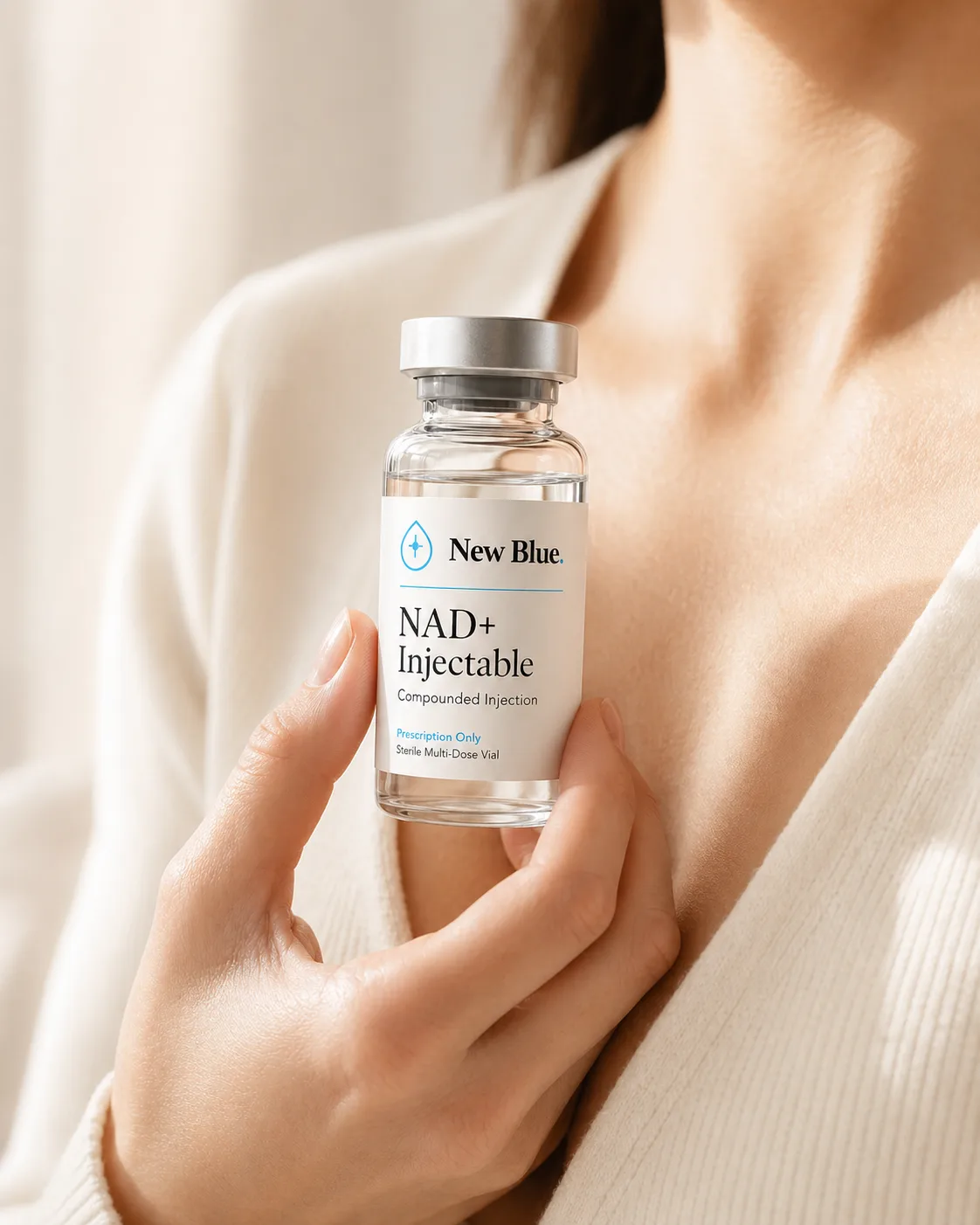
You want to try NAD+ supplementation, and you've narrowed your options to two delivery routes — nasal spray and subcutaneous injection. The problem is that most of the information online either oversells one route without evidence or conflates IV infusion data with injectable self-administration data, which are not the same thing. This article breaks down what we actually know about each delivery method, where the evidence gaps are, and how the two NAD+ pathways available through New Blue Health compare on price, convenience, and practical considerations.
What Is NAD+ and Why Are People Interested in It?
Nicotinamide adenine dinucleotide (NAD+) is a coenzyme present in every living cell, essential for energy metabolism, DNA repair, and sirtuin activation. Interest in exogenous NAD+ supplementation has grown because intracellular NAD+ levels decline with age — Camacho-Pereira et al. (2016) demonstrated that CD38 enzyme activity drives much of this age-related NAD+ depletion in mammalian tissues. The hypothesis is straightforward: if declining NAD+ contributes to metabolic dysfunction and cellular aging, restoring levels might slow or partially reverse those processes.
That hypothesis, while supported by preclinical data, remains under active investigation in humans. Rajman et al. (2018), writing in Cell Metabolism, reviewed the NAD+ "boosting" literature and noted that while animal models show consistent benefits — improved mitochondrial function, enhanced insulin sensitivity, extended lifespan in certain organisms — human clinical trials are still catching up. Most human studies have focused on oral precursors like NR (nicotinamide riboside) and NMN (nicotinamide mononucleotide) rather than direct NAD+ administration. That distinction matters when we talk about delivery routes, because direct NAD+ and its precursors behave differently in the body.
For a deeper look at the evidence base, New Blue Health maintains a dedicated NAD+ evidence page reviewed according to their editorial policy.
NAD+ Nasal Spray: How It Works
Intranasal delivery bypasses the gastrointestinal tract and exploits the rich vascular network of the nasal mucosa to absorb molecules into the bloodstream. The nasal epithelium is thin, highly perfused, and — for certain molecules — offers a relatively direct path to systemic circulation. This route has been used successfully for other compounds: calcitonin, desmopressin, and various peptide hormones have well-established intranasal formulations.
For NAD+ specifically, the nasal spray format works by depositing a fine mist of compounded NAD+ solution onto the nasal mucosa. Absorption happens across the epithelial membrane. The molecule's size (663 Da) is within the range that nasal membranes can handle, though absorption efficiency depends on formulation variables — concentration, pH, the presence of absorption enhancers, and mucosal health.
One practical advantage: no needles. For people who find self-injection uncomfortable or impractical (frequent travelers, those with needle aversion), nasal spray removes a significant barrier. New Blue Health offers NAD+ nasal spray at $299 per unit — one honest all-in price, with the clinical consultation included and no separate consultation fee added on top.
NAD+ Injection: How It Works
Subcutaneous NAD+ injection delivers the compound directly beneath the skin, where it enters the bloodstream via capillary absorption. This is distinct from intravenous (IV) NAD+ infusion, which delivers the molecule directly into the vein — a method typically administered in clinical settings over 1–4 hours. Subcutaneous injection is self-administered at home, usually takes seconds, and doesn't require a clinic visit.
The injectable pathway through New Blue Health is priced at $249 for a 30-day supply or $549 for a 90-day supply — all-in, with the clinical consultation included and no separate consultation fee added on top. All orders include the telehealth consultation, prescription (if appropriate based on clinical review), medication compounded at a state-licensed 503A pharmacy, supplies, and shipping.
Worth noting: subcutaneous injection and IV infusion are often lumped together in online discussions, but they're not pharmacokinetically identical. IV delivery achieves 100% bioavailability by definition — the molecule goes straight into the bloodstream. Subcutaneous delivery has high but not complete bioavailability, with absorption rates influenced by injection site, blood flow, and the molecule's properties.
Bioavailability: Nasal Spray vs. Injection
Bioavailability — the fraction of an administered dose that reaches systemic circulation — is the central question when comparing these two routes. Here's what we can say with reasonable confidence, and where the gaps are.
| Factor | NAD+ Nasal Spray | NAD+ Subcutaneous Injection | |---|---|---| | Route of absorption | Nasal mucosa | Subcutaneous capillary bed | | Estimated bioavailability | Variable; limited human data for NAD+ specifically | High; subcutaneous peptides typically achieve 70–100% | | Onset | Relatively rapid (minutes to onset of absorption) | Moderate (absorption over minutes to hours) | | GI bypass | Yes | Yes | | First-pass metabolism | Largely avoided | Largely avoided | | Self-administration | Yes, no needles | Yes, requires injection supplies | | Formulation sensitivity | High (pH, volume, mucosal condition matter) | Lower (more predictable absorption) |
The honest answer on bioavailability: published head-to-head comparisons of intranasal vs. subcutaneous NAD+ in humans are essentially nonexistent as of mid-2025. We can extrapolate from general pharmacokinetic principles — subcutaneous delivery of small molecules and peptides tends to produce more predictable and often higher bioavailability than intranasal delivery. But "tends to" is not "always does," and NAD+ has its own molecular characteristics that could affect this comparison.
Brenner and colleagues have published extensively on NAD+ metabolism (Brenner, 2017, Current Opinion in Clinical Nutrition and Metabolic Care), but most of this work focuses on oral precursors rather than direct NAD+ delivery via injection or nasal spray. The field needs more pharmacokinetic studies comparing these specific routes.
A licensed clinician reviewing your intake can discuss which route may be more appropriate based on your health profile, goals, and practical preferences. Neither route comes with a promise of specific outcomes — individual responses vary.
Convenience, Comfort, and Practical Considerations
Beyond bioavailability, real-world adherence matters. The most bioavailable delivery route is useless if someone stops using it after two weeks because they hate the process.
Nasal spray advantages:
- No needles, no sharps disposal
- Discreet — can be used almost anywhere
- No injection-site reactions
- Minimal supplies needed
Injectable advantages:
- More predictable dosing (the full dose enters subcutaneous tissue)
- Not affected by nasal congestion, allergies, or sinus conditions
- Well-established self-injection protocols for peptides and other compounds
- Potentially higher and more consistent bioavailability
Nasal spray drawbacks:
- Nasal congestion, rhinitis, or deviated septum can impair absorption
- Taste disturbance (post-nasal drip can create an unpleasant taste)
- Dosing consistency depends on proper spray technique
Injectable drawbacks:
- Requires comfort with self-injection
- Injection-site soreness or irritation is possible
- Needs proper storage and handling of supplies
For someone who travels frequently for work and doesn't want to carry injection supplies through airport security, nasal spray has an obvious practical edge. For someone who already self-administers other subcutaneous medications and wants the most reliable absorption, injectable may make more sense.
Who Might Each Route Suit?
There's no universal "better" option. The right delivery method depends on individual factors that a licensed clinician evaluates during the consultation process.
Nasal spray may be worth discussing if you:
- Have strong needle aversion
- Travel frequently and want minimal supplies
- Prefer a non-invasive daily routine
- Have no significant nasal or sinus conditions
Injectable may be worth discussing if you:
- Are comfortable with self-injection
- Want more predictable absorption characteristics
- Have chronic nasal congestion or sinus issues
- Prefer the cost structure of the injectable pathway ($249/30-day vs. $299 for nasal spray)
The 90-day injectable option at $549 also offers a per-month cost advantage over purchasing nasal spray units individually — something worth considering if a clinician determines the injectable route is appropriate for you and you plan to continue beyond the first month.
Safety Considerations and What to Discuss with Your Clinician
NAD+ supplementation — regardless of delivery route — is not appropriate for everyone. During the telehealth consultation facilitated through New Blue Health, a licensed clinician reviews your medical history, current medications, and health goals before making any prescribing decision.
Questions worth raising with the clinician:
- How does NAD+ interact with any medications you're currently taking?
- Are there contraindications based on your medical history?
- What monitoring, if any, should accompany NAD+ use?
- Which delivery route aligns with your health profile and practical needs?
Compounded NAD+ formulations — whether nasal spray or injectable — are prepared at state-licensed 503A compounding pharmacies. They are prepared to order, not commercially manufactured. New Blue Health maintains a compounding disclosure that explains how compounded medications are sourced and regulated.
Side effects reported in the broader NAD+ literature include flushing, nausea, and mild GI discomfort (more common with oral and IV routes). Injection-site reactions are possible with subcutaneous administration. Nasal irritation or dryness may occur with intranasal use. If you experience unexpected symptoms, contact the prescribing clinician.
How New Blue Health Supports NAD+ Pathways
New Blue Health is a technology and administrative services platform — not a medical provider — that coordinates intake, payment, and care logistics for clinician-guided longevity and metabolic pathways. The platform is LegitScript-certified and available in 48 states (Alabama and Mississippi excluded). Both NAD+ nasal spray ($299) and NAD+ injectable ($249/30-day or $549/90-day) pathways include the telehealth consultation, prescription if appropriate, compounded medication, supplies, and shipping. The price is all-in: one number that already includes the clinical review by an independent licensed clinician, with no separate consultation fee, no membership fee, and no forced subscription. If a clinician determines treatment isn't appropriate, you're refunded your payment minus a $75 clinical consultation, which is non-refundable because the clinical review was still performed. For the 30-day NAD+ pathway ($249), that's a $174 refund. Medical decisions — including whether to prescribe NAD+ and which delivery route to recommend — are made by independent licensed clinicians, not by the platform.
For those interested in complementary longevity pathways, New Blue Health also facilitates access to glutathione (available in injectable and nasal spray formats) through the same clinician-guided process.
Key Takeaways
- NAD+ nasal spray and subcutaneous injection both bypass the GI tract and avoid first-pass metabolism.
- Injectable delivery generally offers more predictable bioavailability, but head-to-head human data comparing these two routes for NAD+ specifically is limited.
- Nasal spray offers a needle-free, portable option; injectable offers potentially more consistent dosing.
- Neither route comes with a promise of specific outcomes. Eligibility depends on clinical review, and individual results vary.
- Both pathways through New Blue Health are one honest all-in price that includes the clinical consultation, prescription (if appropriate), medication, supplies, and shipping — no separate consultation fee, no membership fee, no forced subscription.
Frequently Asked Questions
Is NAD+ nasal spray as effective as NAD+ injections?
Published research comparing intranasal and injectable NAD+ bioavailability in humans is still limited. Early evidence suggests injectable routes may deliver more NAD+ directly into the bloodstream, but nasal spray offers convenience advantages. The best option depends on your individual health profile — discuss with a licensed clinician to determine what may be appropriate for you.
What is the regulatory status of compounded NAD+ products?
Compounded NAD+ formulations — whether nasal spray or injectable — are prepared at state-licensed 503A compounding pharmacies. They are not commercially manufactured finished drug products. Compounding pharmacies operate under state and federal regulations to prepare medications tailored to individual prescriptions.
Can I get NAD+ through New Blue Health?
New Blue Health is a technology and administrative services platform that facilitates patient intake, payment, and care coordination for clinician-guided metabolic and longevity pathways. If appropriate, a licensed clinician may prescribe NAD+. If prescribed, the pharmacy ships directly to you. Eligibility depends on clinical review. Pathways are available in 48 states, subject to pathway and provider availability. Alabama and Mississippi are not currently served.
How much does an NAD+ consultation cost through New Blue Health?
The price is all-in: the clinical consultation is included in the listed pathway price, with no separate consultation fee added on top. If a clinician determines treatment isn't appropriate, you're refunded your payment minus a $75 clinical consultation, which is non-refundable because the clinical review was performed. For the 30-day NAD+ pathway ($249), that's a $174 refund. Consultation timing varies by clinician availability. Visit the New Blue Health website for current pathway pricing.
Who is a good candidate for NAD+ therapy?
Eligibility depends on clinical review by an independent licensed clinician. Not everyone qualifies. Factors such as medical history, current medications, and health goals are considered. New Blue Health does not make medical decisions — a licensed clinician evaluates each patient individually.
Medical Disclaimer: This article is for informational purposes only and does not constitute medical advice, diagnosis, or treatment. All clinical decisions are made by independent licensed clinicians. New Blue Health is a technology and administrative services platform, not a medical provider. Individual results vary, and no specific outcomes are promised. Consult a qualified healthcare professional before beginning any new therapy.
Written by Andy Palenzuela — founder of New Blue Health, with 14+ years in regulated health product supply chains. Clinical content reviewed in accordance with New Blue Health's clinical content team standards.
<!--SCHEMA_JSONLD [ { "@context": "https://schema.org", "@type": "Article", "headline": "NAD+ Nasal Spray vs. Injection: How Delivery Routes Compare", "description": "How does NAD+ nasal spray compare to injectable NAD+? Explore bioavailability, convenience, and who each delivery route may suit. Explore clinician-guided NAD+ pathways starting at $249, all-in (clinical consultation included).", "author": { "@type": "Person", "name": "Andy Palenzuela" }, "publisher": { "@type": "Organization", "name": "New Blue Health", "url": "https://newbluehealth.com" }, "datePublished": "2025-07-11", "dateModified": "2025-07-11", "mainEntityOfPage": { "@type": "WebPage", "@id": "[NAD+ Nasal Spray vs Injection](/blog/nad-nasal-spray-vs-injection)" } }, { "@context": "https://schema.org", "@type": "FAQPage", "mainEntity": [ { "@type": "Question", "name": "Is NAD+ nasal spray as effective as NAD+ injections?", "acceptedAnswer": { "@type": "Answer", "text": "Published research comparing intranasal and injectable NAD+ bioavailability in humans is still limited. Early evidence suggests injectable routes may deliver more NAD+ directly into the bloodstream, but nasal spray offers convenience advantages. The best option depends on your individual health profile — discuss with a licensed clinician to determine what may be appropriate for you." } }, { "@type": "Question", "name": "What is the regulatory status of compounded NAD+ products?", "acceptedAnswer": { "@type": "Answer", "text": "Compounded NAD+ formulations — whether nasal spray or injectable — are prepared at state-licensed 503A compounding pharmacies. They are not commercially manufactured finished drug products. Compounding pharmacies operate under state and federal regulations to prepare medications tailored to individual prescriptions." } }, { "@type": "Question", "name": "Can I get NAD+ through New Blue Health?", "acceptedAnswer": { "@type": "Answer", "text": "New Blue Health is a technology and administrative services platform that facilitates patient intake, payment, and care coordination for clinician-guided metabolic and longevity pathways. If appropriate, a licensed clinician may prescribe NAD+. If prescribed, the pharmacy ships directly to you. Eligibility depends on clinical review. Pathways are available in 48 states, subject to pathway and provider availability. Alabama and Mississippi are not currently served." } }, { "@type": "Question", "name": "How much does an NAD+ consultation cost through New Blue Health?", "acceptedAnswer": { "@type": "Answer", "text": "The price is all-in: the clinical consultation is included in the listed pathway price, with no separate consultation fee added on top. If a clinician determines treatment isn't appropriate, you're refunded your payment minus a $75 clinical consultation, which is non-refundable because the clinical review was performed. For the 30-day NAD+ pathway ($249), that's a $174 refund. Consultation timing varies by clinician availability. Visit the New Blue Health website for current pathway pricing." } }, { "@type": "Question", "name": "Who is a good candidate for NAD+ therapy?", "acceptedAnswer": { "@type": "Answer", "text": "Eligibility depends on clinical review by an independent licensed clinician. Not everyone qualifies. Factors such as medical history, current medications, and health goals are considered. New Blue Health does not make medical decisions — a licensed clinician evaluates each patient individually." } } ] }, { "@context": "https://schema.org", "@type": "MedicalWebPage", "about": { "@type": "MedicalTherapy", "name": "NAD+ supplementation", "description": "Comparison of NAD+ nasal spray and injectable delivery routes for bioavailability, convenience, and practical considerations." }, "lastReviewed": "2025-07-11" } ] -->Medical review & editorial standards
This page is educational content from the New Blue Health Clinical Content Team. It is reviewed under the New Blue Health Medical Review Policy and Editorial Policy and should not replace individualized medical advice from a licensed clinician. For how we evaluate evidence, see Evidence Methodology and Clinical Sources & References.